Chinese
 Español
 Francés
 Deutsch
 Русский
 العربية
 Português
 日本語
日本語
 한국어
한국어
 Italiano

U-Tube vs Heat Pipe Solar Collectors: How to Choose the Right Technology for Your Project
Solar Thermal Engineering • Collector Selection • EPC Decision Guide
U-Tube vs Heat Pipe Solar Collectors: How to Choose the Right Technology for Your Project
A practical comparison for engineers, EPC contractors, and project owners who need to balance efficiency, reliability, climate adaptability, and long-term maintenance in centralized solar thermal systems.
C hoosing a solar thermal collector for a real project is rarely about which technology looks better on paper. For EPC contractors and system designers, the decision usually comes down to a series of practical questions: Will the system run stably all year? How sensitive is it to climate? What happens after five or ten years of operation?
Among evacuated tube technologies, U-tube collectors and heat pipe collectors are the two most commonly discussed options. Both can deliver high thermal efficiency, but they behave very differently once installed in a centralized system. This article explains how to compare them from an engineering and project-decision perspective—so you can choose the technology that truly fits your application.
1) Why “Efficiency” Alone Is Not Enough
In marketing materials, solar collectors are often compared using peak efficiency values. While these figures are useful for standardized testing, they rarely tell the full story of how a collector will behave in a real system.
For centralized hot water and heating projects, the following factors are often more decisive than a single efficiency number:
Seasonal temperature variation and freeze risk
System pressure requirements
Maintenance accessibility and replacement cost
Long-term stability of heat transfer performance
Impact of water quality and scaling
Understanding how U-tube and heat pipe collectors respond to these conditions is the foundation of a rational selection process.
2) How U-Tube Collectors Work in Practice
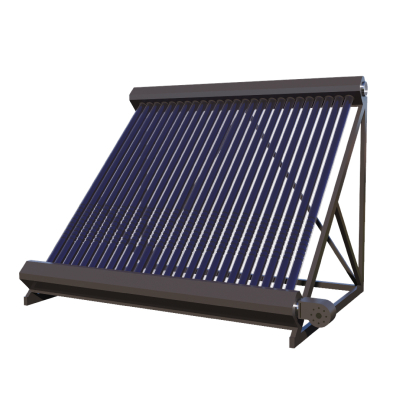
U-tube solar collectors are designed around an indirect heat transfer principle. Solar energy is absorbed inside an evacuated tube and transferred to a U-shaped metal flow channel, where a heat-transfer medium circulates in a closed loop.
The key engineering characteristic is that water does not flow inside the vacuum tube. Instead, the heat-transfer medium carries energy to a heat exchanger or storage tank on the system side. This allows the collector to operate under pressure and significantly reduces risks associated with freezing, overheating, and scaling.
In centralized systems, this design aligns well with long-term operational goals: stable output, predictable behavior, and reduced maintenance intervention.
3) How Heat Pipe Collectors Differ
Heat pipe collectors rely on a sealed pipe containing a working fluid that evaporates and condenses to transfer heat. When solar radiation heats the absorber, the fluid vaporizes and rises to the condenser section, where heat is released to the manifold.
This mechanism enables fast thermal response and strong low-temperature performance, which is why heat pipe collectors are often favored in smaller or distributed systems. However, their long-term reliability depends heavily on the condition of the internal working fluid and the integrity of the sealed pipe.
In large centralized systems, replacement cost and access to individual heat pipes can become a practical consideration during long-term operation.
4) Side-by-Side Engineering Comparison
| Aspect | U-Tube Collector | Heat Pipe Collector |
|---|---|---|
| Heat transfer method | Indirect, circulating heat-transfer medium | Phase-change working fluid inside pipe |
| Pressurized operation | Supported | Typically limited |
| Freeze protection | Excellent (glycol circulation) | Good (sealed pipe) |
| Maintenance impact | Low, system-level maintenance | Medium, individual pipe replacement |
| Typical system scale | Medium to large centralized systems | Small to medium, distributed systems |
5) Which Technology Fits Your Project?
The selection between U-tube and heat pipe collectors should always be linked to project conditions, not abstract performance claims.
U-tube collectors are often preferred when:
The system is centralized and pressurized
Long-term stability is more important than rapid start-up
Freeze protection and scaling control are critical
Maintenance access is limited or costly
Heat pipe collectors may be more suitable when:
Fast response is required
System scale is relatively small
Individual tube replacement is easy and acceptable
Engineering Conclusion
There is no universally “better” collector—only a technology that fits your project conditions. In centralized solar thermal systems where reliability, freeze resistance, and lifecycle cost matter, U-tube collectors are frequently selected as a balanced and robust solution.
Not Sure Which Collector Fits Your Project?
Choosing between U-tube and heat pipe collectors depends on climate, system scale, operating pressure, and long-term maintenance strategy. A generic answer rarely works.
👉 Tell us your project type, location, and heating demand, and the Soletks Solar engineering team can help you evaluate the most suitable collector configuration—without changing your system concept or adding unnecessary complexity. Contact export@soletksolar.com today!