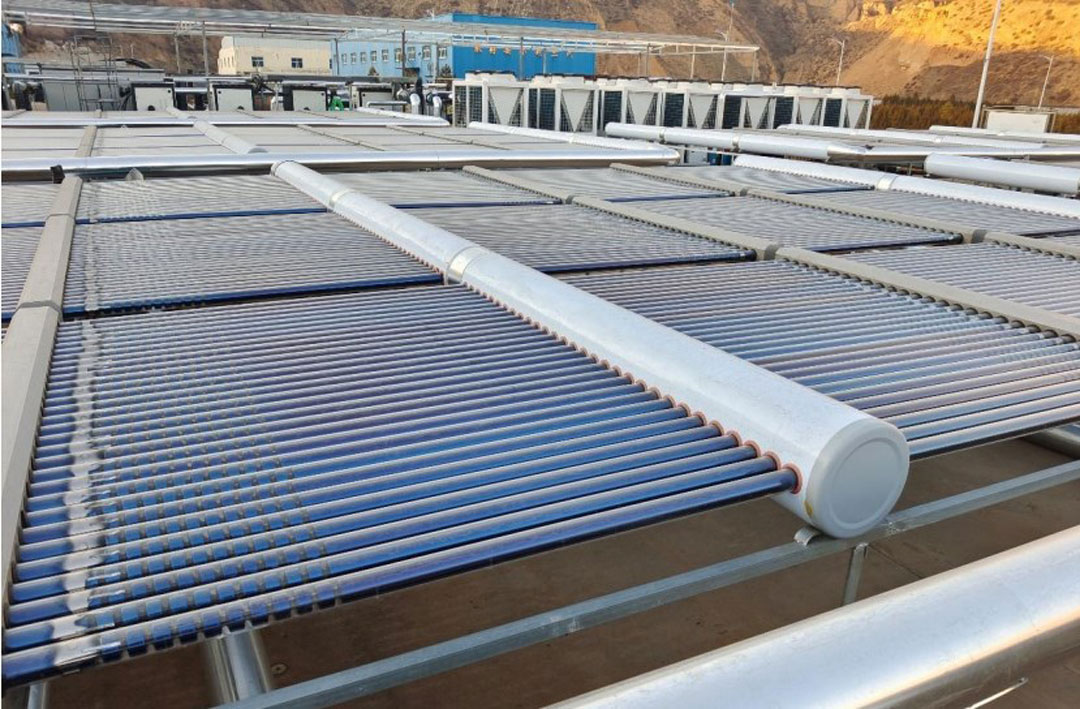
Solar Collector + Heat Pump Heating System for a 24,000 m² Coal Mine Office Building

2025/09/17 16:01


Project Case Study

Solar Collector + Heat Pump Heating System for a 24,000 m² Coal Mine Office Building

How a dual-source solar thermal system replaced electric heating in Yulin, Shaanxi — delivering 300,000 kWh annual savings with a 4-year payback period. Engineering analysis for B2B buyers evaluating large-scale commercial heating solutions.

A solar collector and heat pump coupled heating system replaced conventional electric heating in a 24,000 m² coal mine office building in Yulin, Shaanxi Province, China. Commissioned in 2021, the system delivers stable indoor temperatures through harsh winters, saves 300,000 kWh of electricity annually, and achieved full investment payback within four years. This case study breaks down the technical design, cold-climate engineering approach, and measured results — with observations relevant to B2B buyers evaluating similar systems for industrial or large commercial buildings.

Why Coal Mining Facilities Need Solar Heating Alternatives

Coal mining operations in northern China face a specific heating contradiction. These facilities sit on top of abundant fossil fuel resources, yet burning coal for space heating is increasingly restricted under national decarbonization policy. Electric resistance heating solves the emissions problem locally but creates massive operating costs — particularly for buildings exceeding 10,000 m² in regions with 4–5 month heating seasons and ambient temperatures routinely dropping below -15°C.

The Yulin area of Shaanxi Province represents this challenge clearly. As one of China's largest coal-producing regions, local enterprises face pressure to demonstrate environmental compliance while maintaining operational continuity. Traditional coal-fired boilers are being phased out. Pure electric heating, while clean at the point of use, carries electricity costs that scale linearly with building area — and in cold climates, those costs can exceed what many industrial operators consider acceptable.

This creates a practical opening for solar thermal systems coupled with heat pumps: a design that leverages free solar radiation during daylight hours while using heat pump technology to bridge the gap during cloudy periods and nighttime. The engineering question is whether such systems can deliver reliable heat at scale — particularly in buildings above 20,000 m² and in climates that regularly see -20°C.

Project Scope: 24,000 m² Office Building in Yulin, Shaanxi

The project site is a coal mine administrative complex in Yulin, consisting of office areas, meeting rooms, and staff facilities totaling 24,000 m² of heated floor area. The system was commissioned in 2021.

Key site parameters: The heating season extends from mid-November through mid-March (approximately four months). Winter temperatures regularly reach -15°C to -20°C. Solar irradiance in the Yulin region is relatively strong — clear-sky days are common in the dry winter months. The building operates on a daytime schedule (office use), aligning well with peak solar collection hours.

The project goal was to provide full heating coverage for the entire 24,000 m² area, maintaining 18–22°C indoor temperatures throughout the heating season, while achieving substantial reductions in both electricity consumption and carbon emissions compared to the previous pure electric heating system.

Technical Design: How the Solar-Heat Pump Coupling Works

The system uses a dual-source architecture that combines engineering-grade flat plate solar collectors with air-source heat pumps. Neither technology operates alone — the design logic depends on intelligent switching between solar-primary and heat-pump-primary modes based on real-time conditions.

Engineering Manifold Flat Plate Collectors

The solar collection array uses large-format engineering flat plate collectors designed for commercial-scale installations. Unlike residential-sized panels, these collectors feature expanded absorption areas (exceeding 10 m² per unit), manifold-style internal flow channels, and structural engineering suited to wind loads typical of northern Chinese plateaus.

Flat plate collectors were selected over evacuated tubes for this application for several reasons. In high-wind environments, flat plate panels present a more stable profile with lower risk of mechanical damage. Their modular manifold design allows series-parallel configurations that simplify hydraulic balancing across large arrays. They also tolerate partial shading and temperature cycling without the degradation risks that vacuum seal failures introduce in tube collectors over 15+ year service lives.

The collector array heats a glycol-water mixture, which transfers thermal energy to a buffer storage system. From there, heat is distributed to the building through a conventional hydronic loop.

Air-Source Heat Pump as Auxiliary

Air-source heat pumps provide supplementary heating when solar collection is insufficient — during overcast conditions, early morning hours, and periods of extreme cold. The heat pumps operate on a coefficient of performance (COP) significantly above 1.0, meaning they deliver more thermal energy than the electrical energy they consume. Even at -20°C ambient temperature, modern commercial air-source heat pumps maintain useful COP values (though lower than at milder temperatures).

The economic advantage over pure electric heating is substantial: heat pumps consume roughly one-quarter to one-third of the electricity that direct resistance heating requires for the same thermal output.

Intelligent Mode Switching Logic

Clear Sky Mode

Solar collectors serve as the primary heat source. Collected thermal energy is used directly or stored in the buffer tank. Heat pumps remain on standby, minimizing electricity consumption.

Cloudy / Partial Overcast

Both systems operate simultaneously. Solar collectors contribute whatever energy is available; heat pumps supplement the shortfall. Avoids oversizing either system.

Extreme Cold / Extended Overcast

Heat pumps carry the primary load. Residual heat in the storage system from prior solar collection is used first, reducing heat pump run time and peak electricity demand.

Design Rationale

A pure solar system would require impractical storage or enormous arrays. A pure heat pump system would carry unnecessarily high electricity costs during clear-sky days. The coupled approach optimizes across both scenarios.

Cold-Climate Engineering: Maintaining Heat Output Below -20°C

Reliable performance at -20°C requires specific engineering choices beyond standard solar thermal practice:

Antifreeze System

The collector array uses a glycol-water heat transfer fluid with freezing point well below -30°C, preventing pipe damage during overnight stasis. The manifold design minimizes stagnant fluid pockets where freezing could initiate.

Cold-Rated Heat Pumps

Heat pumps selected for this project are rated for operation at ambient temperatures as low as -25°C. Their defrost cycles are engineered for sustained sub-zero operation without efficiency collapse.

Pipe Insulation

Specified for the extreme temperature differential between hot fluid (60°C+) and ambient air (-20°C). Poorly insulated piping causes substantial parasitic heat loss that undermines the solar fraction calculation.

Buffer Storage Sizing

Sized to bridge daytime solar collection and evening heat demand. Too small forces excessive heat pump compensation; too large escalates capital cost without proportional benefit.

Measured result: Indoor temperatures remained within the 18–22°C target range throughout the heating season, including during periods when outdoor temperatures dropped to -20°C.

Measured Project Results After Implementation

Energy and Cost Savings

300,000    kWh Saved Annually
~100 t    Standard Coal Avoided / Year
4 Years    Investment Payback
3.75M CNY    15-Year Cumulative Savings

The system saves 300,000 kWh of electricity per year compared to the previous pure electric heating installation. At local commercial electricity rates, this translates to approximately 250,000 CNY (roughly USD 35,000) in annual operating cost reduction. The reduction in standard coal equivalent consumption is approximately 100 tons per year.

Cumulative electricity cost savings projected over the system's 15-year design life: approximately 3.75 million CNY (roughly USD 520,000). The investment payback period, based on measured first-year savings against installed system cost, was achieved within four years.

A four-year payback is notable for a commercial heating system. For comparison, many commercial solar PV installations in favorable markets achieve payback in 5–8 years. The combination of high electricity offset, strong solar resource, and the heat pump's efficiency multiplier effect all contributed to this relatively short payback in the Yulin project.

Carbon Reduction Impact

644 t    CO₂ Reduced Annually
Zero    Local Air Pollutants
~36,000    Equivalent Trees Planted / Year

Annual carbon dioxide emission reduction: 644 tons. This figure is calculated based on the grid emission factor for the Shaanxi electricity grid, reflecting the actual carbon intensity of the power displaced. Unlike coal-fired boilers, the system produces no local air pollutants — no sulfur dioxide, no particulate matter, no nitrogen oxides at the building site. For facilities facing environmental compliance audits, eliminating local combustion emissions also reduces regulatory risk.

Planning a solar heating system for a commercial or industrial building above 5,000 m²? Get a preliminary sizing recommendation from Soletks engineering.

Request Consultation

What B2B Buyers Can Learn From This Project

This case offers transferable insights for buyers evaluating solar-heat pump coupled systems — regardless of whether the application is a coal mine, factory complex, logistics center, or commercial building cluster.

System Selection Criteria for Large Commercial Heating

Building area alone does not determine system design. The critical inputs are: heating load per square meter (depends on insulation quality, building orientation, internal heat gains), local climate severity (heating degree-days), solar resource availability (kWh/m²/year on the tilted collector plane), electricity cost, and acceptable payback period.

For buyers evaluating this architecture: For buildings in the 10,000–50,000 m² range with heating seasons of 3–5 months and ambient temperatures regularly below -10°C, the solar-collector + heat-pump architecture tends to outperform pure electric or pure solar solutions on a lifecycle cost basis — provided the solar resource is adequate and collector array area is available.

Ask any potential system supplier for: a thermal simulation showing expected solar fraction by month, projected electricity consumption of the heat pumps under design-day conditions, and a clear payback calculation with stated assumptions.

Evaluating Supplier Engineering Capability

The value of a supplier in this type of project goes beyond panel sales. A credible supplier for solar-heat pump coupled heating systems should provide:

CapabilityWhat to Ask For
System design supportCollector array sizing, buffer tank specification, heat pump selection, hydraulic design
Climate-specific engineeringAntifreeze requirements, wind load considerations, defrost cycle implications for your location
Reference projectsProjects of comparable scale (>10,000 m²) in comparable climates
Commissioning supportInitial tuning of mode-switching logic and storage control strategy
Performance dataMeasured first-year results from previous installations, not just modeled projections

If a supplier can only quote panel prices but cannot discuss system architecture, their offering is incomplete for this application category. Look for manufacturers who understand the full chain from collector selection to system commissioning. For a detailed procurement evaluation framework, see our guide on how to choose a collector manufacturer for commercial projects.

Soletks Engineering Capabilities for Commercial Solar Heating Projects

Soletks (Shandong Soletks Solar Technology Co., Ltd.) supplied the engineering flat plate collectors used in this Yulin coal mine project. The EFPC series large-format collectors were selected for their manifold flow design, structural suitability for high-wind environments, and thermal efficiency characteristics.

EFPC Series Engineering Flat Plate Collectors

Designed for large-scale centralized heating, district energy, and commercial hot water applications where installation speed and per-unit coverage area directly affect project economics.

10.48–13.92 m²      Lighting Area Per Unit
0.79–0.81      Peak Efficiency
80% Faster      Installation vs. Conventional

Soletks has deployed similar systems across multiple large-scale projects in China, including a 107,000 m² centralized solar heating installation in Shigatse, Tibet — one of the world's highest-altitude solar heating projects — and a school heating project in Tianjin using their TPV Pro + heat pump configuration.

For international B2B buyers, Soletks operates as a direct manufacturer based in Dezhou, Shandong Province, with engineering and production capacity to support OEM/ODM requirements, custom specifications, and project-specific consultation. The company holds Solar Keymark certification, ISO 9001, ISO 14001, and ISO 45001 management system certifications. Explore the full commercial solar thermal collector range for model-specific data.

Frequently Asked Questions

Can a solar collector + heat pump system really heat a 24,000 m² building through an entire winter?

Yes — but the system must be correctly designed for the specific climate and building load. The Yulin project demonstrates that with adequate collector array area, properly sized thermal storage, and commercial-grade heat pumps rated for sub-zero operation, the coupled system can maintain 18–22°C indoor temperatures even at -20°C outdoors. The key is the dual-source architecture: solar covers a substantial portion during clear days, while heat pumps ensure continuity during cloudy periods and extreme cold.

What is a realistic payback period for this type of commercial solar heating system?

The Yulin project achieved payback within four years — on the faster end for commercial solar thermal. Payback depends on local electricity price, solar resource quality, building insulation level, and heating season length. For projects in cold climates with electricity costs above 0.6 CNY/kWh and strong winter solar irradiance, 4–6 year paybacks are realistic. In regions with lower electricity costs or shorter heating seasons, payback may extend to 6–8 years.

Why were flat plate collectors chosen over evacuated tube collectors?

Flat plate collectors offer advantages in high-wind environments: lower wind resistance, reduced mechanical damage risk, and simpler maintenance. Their manifold design allows straightforward hydraulic balancing in large arrays. Evacuated tubes can deliver higher temperatures per unit area but are more vulnerable to seal degradation over 15+ year lifespans and require more careful installation in windy sites. For more detail, see our flat plate vs evacuated tube comparison.

How much maintenance does a solar-heat pump coupled system require?

Routine maintenance includes annual glycol concentration checks, visual inspection of collector glazing and pipe insulation, heat pump filter cleaning, and control system verification. The modular design means individual collector units can be isolated and serviced without shutting down the entire system — a significant advantage over coal-fired boilers that require extended maintenance shutdowns.

Is this system design applicable outside China?

The engineering principles are fully transferable. Solar-heat pump coupled systems are already deployed in northern Europe, Canada, and other cold-climate regions. Specific collector models, heat pump specifications, and control logic are adapted to local climate data and building codes. Soletks supplies equipment internationally and provides engineering consultation for projects in Europe, the Middle East, and other B2B markets.

Evaluate Soletks for Your Next Commercial Heating Project

Share your project parameters and receive a technical quotation with system recommendations.

     Collector array sizing and layout
     Heat pump coupling recommendations
     Payback estimate based on your climate
     OEM/ODM and custom specifications
     Reference project documentation
     Logistics and lead time planning
Request Engineering Consultation