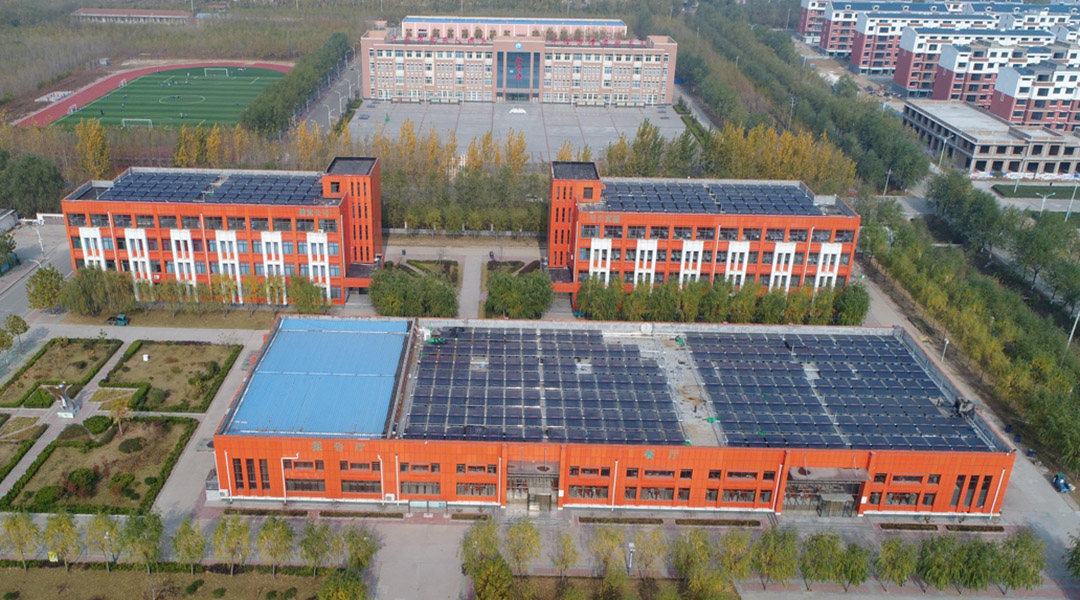
Solar Hot Water System for a School Campus: 180 Tons/Day Serving 3,000 Users

2025/09/17 16:11


Campus Project Case Study

Solar Hot Water System for a School Campus: 180 Tons/Day Serving 3,000 Users

How a 750 m² flat plate collector array replaced gas boilers at a boarding school in Shandong, China — cutting operating costs by 72% with a 3.5-year payback. Engineering insights for B2B buyers evaluating institutional solar hot water projects.

A centralized solar hot water system delivering 180 tons of hot water per day was commissioned at Huimin No.3 Middle School in Shandong Province, China, replacing the school's gas-fired boiler infrastructure. The system serves nearly 3,000 teachers and students across dormitories, canteens, and office buildings, reducing annual operating costs by over 2.8 million CNY compared to gas supply. This case study examines the system design, demand-matching logic, safety engineering, and financial performance — with takeaways applicable to institutional hot water projects in schools, hospitals, and public facilities internationally.

Why Schools Are Switching From Gas Boilers to Solar Hot Water

Boarding schools with more than 1,000 students face a persistent operational burden: large-volume hot water demand concentrated into narrow daily time windows, combined with the requirement for absolute supply reliability. Gas-fired boilers historically served this role, but they carry three escalating disadvantages for institutional operators.

First, fuel cost volatility. Natural gas pricing is subject to seasonal surges and supply-chain constraints — particularly during winter heating periods when demand peaks across the grid. For a school producing 180 tons of hot water daily, gas costs can exceed 10,000 CNY per day at current market rates in northern China.

Second, emission compliance. Combustion-based systems produce CO₂, NOx, and particulate matter at the point of use. As municipal and provincial governments tighten emission standards for public institutions — particularly schools where student health is a regulatory sensitivity — gas boiler continued operation becomes an administrative liability rather than just an economic one.

Third, maintenance complexity. Gas boilers require licensed operators, annual safety inspections, combustion tuning, flue gas monitoring, and fuel storage management. These create recurring overhead that solar thermal systems largely eliminate.

Solar hot water systems address all three issues simultaneously: the primary energy source is free, there are no combustion emissions, and routine maintenance is limited to periodic fluid checks and visual inspections. The engineering challenge is designing a system that reliably matches institutional demand profiles — particularly the sharp morning and evening peaks characteristic of boarding schools.

Project Overview: Huimin No.3 Middle School, Shandong Province

Huimin No.3 Middle School is a public boarding school in Huimin County, Binzhou City, Shandong Province. The campus hosts approximately 3,000 teachers and students, with boarding students accounting for more than 60% of the population — approximately 2,200 individuals requiring daily hot water for bathing and personal hygiene.

180 t/day    Hot Water Output
750 m²    Collector Array Area
~3,000    Daily Users Served

The project was constructed in the second half of 2023 and entered full operation in early 2024. It replaced gas-fired boilers that had previously served the campus hot water needs at significantly higher operating cost and lower supply reliability during winter months.

Project context: In 2023, the local Education and Sports Bureau launched a "Green Campus" initiative requiring priority adoption of renewable energy in public schools. This project was the first large-scale campus solar hot water installation in Huimin County.

System Design: Matching 180 Tons of Daily Hot Water Demand

The system design was driven by three constraints: total daily volume (180 tons at 55–60°C), peak-hour flow rates (simultaneous use across 6 dormitory buildings and 3 canteens), and all-weather reliability (including extended cloudy periods in winter). The solution uses a "centralized collection + distributed storage" architecture.

Collector Array and Storage Configuration

The solar collection array consists of 300 flat plate solar collectors, each with an aperture area of 2.5 m², for a total collection area of 750 m². The collectors are installed on the rooftops of teaching buildings flanking the school sports field — an orientation that maximizes south-facing exposure while avoiding interference with playground activities below.

Thermal storage is handled by four 50 m³ insulated hot water tanks (200 m³ total capacity), providing approximately 10% emergency buffer above the 180-ton daily requirement. This buffer accommodates demand variation between weekdays and weekends, and provides continuity during collector maintenance periods.

Usage CategoryDaily VolumeShare of TotalPrimary Hours
Student dormitory use (2,200 boarders)110 tons61%06:00–08:00, 18:00–22:00
Canteen use (3 facilities)40 tons22%05:30–07:30, 11:00–13:30, 17:00–19:00
Office and teaching buildings30 tons17%08:00–17:00

Peak-Hour Water Supply Engineering

Campus hot water demand is not evenly distributed. Over 70% of daily consumption is concentrated into three peak windows: early morning (06:00–08:00), midday (11:30–13:30), and evening (18:00–22:00). The system must deliver adequate flow rates and pressure during these windows — otherwise, upper-floor dormitories experience low pressure or cold water, which is the most common complaint in institutional hot water installations.

The solution employs variable-frequency water pumps that increase supply pressure during peak periods. Flow rate is dynamically adjusted based on real-time demand signals, ensuring consistent pressure even when 6 dormitory buildings and 3 canteens draw water simultaneously. During off-peak hours, pump speed decreases automatically, reducing electricity consumption.

Air-Source Heat Pump Backup

An air-source heat pump system provides auxiliary heating when solar collection is insufficient — during extended overcast periods, heavy rain, or winter days with minimal irradiance. The heat pumps are non-direct-electric-heating type, meaning they operate via refrigerant compression rather than resistance elements. This distinction matters for campus safety compliance: resistance heating in large water systems carries higher electrical fault risk, while heat pump systems separate the electrical components from the water circuit.

The smart temperature control system monitors tank water temperature continuously. When the temperature drops below the setpoint and solar input is inadequate, heat pumps activate automatically without manual intervention. This ensures the system maintains 55–60°C output temperature regardless of weather conditions.

Safety and Maintenance Design for Campus Environments

School installations carry stricter safety requirements than standard commercial buildings. The user population includes minors, and regulatory frameworks in many jurisdictions impose additional scrutiny on building systems that serve students. This project addresses campus-specific concerns through several engineering measures:

Anti-Scald Protection

Thermostatic mixing valves at point-of-use outlets prevent water temperatures from exceeding safe limits at taps, even if stored water temperature is higher than delivery temperature.

Water Quality Management

Dual overflow valves and inline filtration systems in the storage tanks. Monthly automated detection of water hardness and bacterial indicators prevents scale buildup and microbial growth.

Rooftop Safety

Anti-fall brackets secure all collector panels. Roof pipelines are wrapped with thermal insulation and aluminum sheathing — preventing winter freezing, UV degradation, and accidental contact by students during rooftop access.

Remote Monitoring

School logistics staff monitor real-time hot water output, tank levels, and equipment status via a mobile management platform. Fault conditions trigger automatic alarm notifications — eliminating the need for 24-hour on-site personnel.

Maintenance advantage over gas boilers: The solar system eliminates the need for licensed gas boiler operators, annual combustion safety inspections, flue gas monitoring, and fuel inventory management. Routine maintenance is limited to periodic glycol checks (in closed-loop systems), visual panel inspection, and pump servicing — tasks that school maintenance staff can handle without specialized boiler certifications.

Measured Economic Results

72%    Operating Cost Reduction vs. Gas
2.8M CNY    Annual Savings
3.5 Years    Investment Payback
15 Years    System Design Life

The cost comparison against the previous gas boiler system is substantial. To produce 180 tons of hot water daily using gas boilers at local rates (3.8 CNY/m³), the school consumed approximately 2,880 m³ of natural gas per day — a daily fuel cost exceeding 10,900 CNY. The solar system's daily operating cost (primarily auxiliary heat pump electricity at approximately 800 kWh × 0.56 CNY/kWh, plus maintenance allocation) totals less than 3,000 CNY per day.

The resulting annual savings exceed 2.8 million CNY (approximately USD 390,000). Against the total system investment, this yields a payback period of approximately 3.5 years — after which the system generates net savings for the remaining 11+ years of its design life.

Financial context for international buyers: A 3.5-year payback on institutional solar hot water is achievable when three conditions align: high baseline energy costs (gas or electricity), large daily volume (>50 tons), and adequate solar resource. In regions with lower energy costs or smaller daily volumes, paybacks of 5–7 years are more typical. The key variable is the displaced fuel cost per ton of hot water produced.

Need a preliminary cost estimate for a campus or institutional solar hot water system? Share your daily volume requirement and location.

Get a Project Quote

Applicability for International School and Institutional Projects

The system architecture demonstrated in this project — centralized flat plate collectors, insulated buffer storage, variable-frequency distribution pumps, and air-source heat pump backup — is directly transferable to institutional hot water applications outside China. Schools, universities, hospitals, military barracks, worker housing complexes, and similar facilities share the same demand profile: high daily volume, predictable usage patterns, and concentrated peak hours.

For international B2B buyers evaluating this type of system for their market, the key design parameters that translate across geographies include:

Sizing Logic

50 liters per person per day at 55–60°C is a standard baseline for boarding institutions. Adjust up for facilities with commercial kitchens or laundry services; adjust down for day-use-only buildings.

Collector Area Ratio

Approximately 4–5 m² of flat plate collector area per 1,000 liters of daily hot water demand (climate-dependent). In high-irradiance regions, this ratio decreases; in northern/cloudy climates, it increases.

Storage Sizing

Total storage capacity should exceed one day's demand by 10–15% to accommodate weather variability and maintenance windows without supply interruption.

Backup Strategy

Air-source heat pumps suit most climates above -15°C ambient. Below that, ground-source or electric backup may be necessary. For campuses, non-resistance-heating backup is preferred for safety compliance.

Distributors and EPC contractors serving the education sector or public institution market can reference this project as a scalable model. The design accommodates facilities ranging from 500 to 10,000+ users by adjusting collector count, storage tank capacity, and pump configuration proportionally.

Soletks Commercial Solar Hot Water Solutions

Soletks supplied the engineered flat plate collectors used in this school project. The FPC200-HM model — a 2.0 m² modular collector designed for multi-unit series connection — was selected for its balance of per-unit cost efficiency, hydraulic compatibility in large arrays, and structural durability suited to rooftop installation.

Soletks Flat Plate Collectors for Institutional Hot Water

Modular design supports series connection across arrays of 50–500+ units. Optimized for centralized hot water applications in schools, hospitals, hotels, and public facilities.

0.78      Peak Efficiency
15+ Years      Design Service Life
OEM/ODM      Custom Specification Support

For larger institutional projects requiring maximum coverage area per panel, the EFPC series (10–15 m² per unit) is also available — as demonstrated in our commercial solar thermal applications portfolio. Soletks operates as a direct manufacturer in Dezhou, Shandong Province, with capacity for custom sizing, private labeling, and project-specific engineering consultation.

The company holds Solar Keymark certification for its flat plate collector range, along with ISO 9001, ISO 14001, and ISO 45001 management system certifications. For more on how Soletks approaches institutional and hotel solar hot water projects, see our application documentation.

Frequently Asked Questions

How large a collector array is needed for 180 tons of hot water per day?

This project uses 750 m² of flat plate collector area to produce 180 tons at 55–60°C daily in Shandong Province's solar resource conditions. The general ratio is approximately 4–5 m² per 1,000 liters of daily demand, but this varies by latitude, average irradiance, and backup system capacity. A supplier should provide a site-specific sizing calculation based on your location's TMY (Typical Meteorological Year) data.

What happens during extended cloudy or rainy periods?

The air-source heat pump backup activates automatically when tank temperature drops below setpoint and solar input is insufficient. The system maintains 55–60°C output regardless of weather. Storage buffer (200 m³ in this project) provides additional time margin before backup systems need to engage at full capacity.

Is the 3.5-year payback realistic for projects outside China?

Payback depends primarily on the cost of the energy source being displaced. In this project, natural gas at 3.8 CNY/m³ was the baseline. In markets with higher gas or electricity prices, payback may be shorter. In markets with subsidized energy prices or lower solar resources, payback extends. For most institutional projects above 50 tons/day with adequate solar irradiance, 3–7 year paybacks are the typical range.

Can this system design scale to larger institutions — universities or hospitals?

Yes. The architecture is modular by design. Collector count, tank number, and pump capacity scale proportionally with demand. University campuses producing 500+ tons/day use the same principle with larger EFPC-series collectors and additional storage tanks. Hospital projects may require higher delivery temperatures (65–70°C) for sterilization purposes, which affects collector sizing and backup system specification.

What maintenance does the school need to perform?

Routine tasks include visual inspection of collector panels (quarterly), glycol concentration check in closed-loop circuits (annually), water quality filter replacement (per schedule), pump servicing (annually), and control system firmware updates (as released). All tasks can be performed by general maintenance staff without specialized boiler certifications — a significant reduction in personnel requirements compared to gas boiler operations.

Plan Your Institutional Solar Hot Water Project

Share your facility details and daily hot water volume requirement for a tailored system recommendation and quotation.

     Collector array sizing for your climate
     Storage and distribution design
     Payback estimate based on local energy costs
     OEM/ODM and private labeling options
     Reference project data and documentation
     Lead time and logistics planning
Request Engineering Consultation