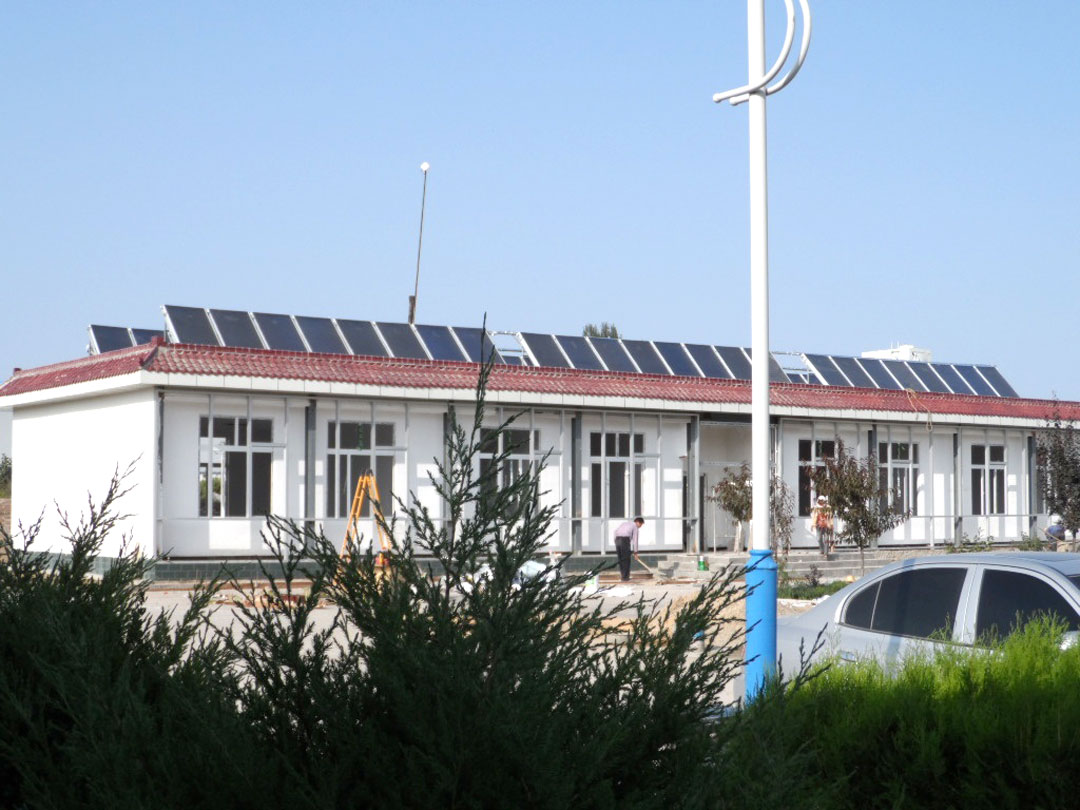
Solar Heating for a –15 °C Office Building in Yinchuan, China (Flat Plate Case Study)
Solar Heating for a 285 m² Office Building at −15 °C in Yinchuan
48 flat plate collectors feeding floor heating cover over 80% of winter demand, lift indoor temperatures from 10 °C to above 18 °C, and cut 10.2 tonnes of CO₂ a year.
Location
Minning Town, Yinchuan, Ningxia
Application
285 m² office building heating
System Type
Flat plate solar + floor heating, electric-assisted
Collector Area
48 collectors · 96 m² total
Commissioning
Winter 2023
Client Type
Public green-energy demo project
Background: Two Demands That Pointed to Solar
Minning Town sits in a temperate continental climate with a long, cold heating season from November to March and winter lows reaching −15 °C. The 285 m² office building previously ran on electric heating that cost over 3,000 yuan a month — about 15,000 yuan a year — yet still left corners below 16 °C.
As a local green energy-saving demonstration project, the building needed a system that could resist −15 °C cold, hold a stable indoor temperature, and cut running cost at the same time. Those demands ruled out simply keeping the existing electric setup.
Yinchuan's roughly 2,800 annual sunlight hours made a "solar-led, electric-assisted" design the logical choice: it uses abundant local clean energy while keeping a backup for extreme weather.
The Challenges
A small public building in a cold northern region faces a specific cluster of problems that a generic solar layout will not solve.
High electric heating cost
The old system cost over 3,000 yuan/month (about 15,000 yuan/year) — a heavy load on a town-level public budget.
Uneven temperatures
Corners dropped below 16 °C, with sharp gaps between rooms that made the building uncomfortable to work in.
−15 °C cold and cloudy spells
A five-month heating season with sub-zero lows and snowy days demands reliable backup, not solar alone.
Low renovation budget
As a demo for small/medium public buildings, the solution had to stay modular and low-cost to be replicable.
Solution Overview
The system pairs cold-capable flat plate collectors with floor heating and a temperature-difference-controlled electric backup. The design priority was reliable winter heat in a cold climate, not maximum summer yield — which is why array geometry, control logic, and storage were engineered around the worst weeks, not the average.
South-roof array at 35°
48 flat plate collectors installed in series + parallel on the south roof at a 35° tilt to maximize winter sun capture.
Floor heating delivery
Collectors feed indoor floor heating; at 300 W/m² irradiance, water reaches 50–60 °C and lifts rooms from 10 °C to above 18 °C in 2–3 hours.
Temp-difference electric backup
A 3 kW heater starts only when the temperature gap falls below 5 °C, so backup runs sparingly rather than continuously.
Thermal storage buffer
A 500 L tank stores hot water; even across two consecutive cloudy days, auxiliary use stays around 15 kWh/day.
System Configuration
Flat Plate Collectors
48 units · 2 m² each · 96 m² total · covers 80%+ of winter heating demand
Array Layout
Series + parallel on south roof · 35° tilt for maximum winter irradiance
Heat Delivery
Indoor floor heating · 50–60 °C supply at 300 W/m² irradiance
Auxiliary Heat Source
3 kW electric heater · temp-difference sensing trigger (<5 °C gap)
Storage Tank
500 L hot water buffer · ~15 kWh/day backup across 2 cloudy days
Zoned Control
22 °C for occupied rooms, 16 °C for vacant rooms · ±2 °C uniformity
Before vs After
The comparison shows the change is structural — cost, comfort, and emissions all shift at once.
| Indicator | Before (Electric) | After (Solar-Led) | Improvement |
|---|---|---|---|
| Heat source | Full electric heating | 80%+ solar + electric backup | Solar-led conversion |
| Indoor temperature | Below 16 °C in corners | Above 18 °C, ±2 °C uniformity | Stable comfort |
| Annual electricity for heating | Baseline | 13,000 kWh less / year | Major reduction |
| Annual CO₂ | Baseline | 10.2 t less / year | 8.16 t direct cut |
| Control | Uniform, no zoning | Zoned (22 °C / 16 °C) | Flexible operation |
80%+
Winter heating from solar
13,000
kWh electricity saved per year
10.2 t
CO₂ cut per year
18 °C+
Stable indoor temperature
Heating a building in a cold region? Get a flat plate solar system designed for sub-zero winters.
Request a Similar QuoteKey Takeaways for Cold-Region Building Heating
This project is most useful as a template for small and medium public buildings — town offices, community centers, clinics — in cold climates.
Solar heating works below 0 °C
With the right tilt, array layout, and backup, flat plate solar covered 80%+ of heating demand at −15 °C — breaking the "solar is only for the south" assumption.
Control logic decides backup cost
Temperature-difference triggering kept the 3 kW heater idle most of the time, holding auxiliary use to ~15 kWh/day even on cloudy days.
Pair collectors with floor heating
Low-temperature floor heating (50–60 °C) matches flat plate output well and delivers even ±2 °C comfort.
Modular = replicable
A standardized 2 m² collector module keeps renovation cost and complexity low enough for grassroots public buildings to adopt.
Frequently Asked Questions
Can flat plate solar heating really work at −15 °C?
Yes. In this project, 48 flat plate collectors on a 35° south roof covered over 80% of winter heating demand at −15 °C, with an electric backup for the coldest, cloudiest spells. Correct tilt, array layout, and freeze-aware design are what make it work in cold regions.
What happens on cloudy or snowy days?
A 500 L storage tank buffers hot water, and a temperature-difference module starts a 3 kW electric heater only when the indoor gap falls below 5 °C. Even across two consecutive cloudy days, auxiliary use stayed around 15 kWh/day.
How much can a small office building save?
The system cut about 13,000 kWh of heating electricity per year and 10.2 tonnes of CO₂, with 8.16 tonnes from the direct solar share. Savings depend on local tariffs, building envelope, and irradiance, so each site should be recalculated.
Why use floor heating instead of radiators?
Floor heating runs on lower water temperatures (50–60 °C), which matches flat plate collector output efficiently and delivers even ±2 °C temperatures without hot and cold spots.
Is this suitable for other small public buildings?
Yes. The modular 2 m² collector approach and zoned control make it a low-cost, replicable model for town offices, community centers, and similar small/medium buildings in cold northern regions.