Chinese
 Español
 Francés
 Deutsch
 Русский
 العربية
 Português
 日本語
日本語
 한국어
한국어
 Italiano

Lanzhou Yongdeng Rural Winter Heating Clean Energy Transformation Project
Against the backdrop of integrating the "dual-carbon" strategy with rural revitalization, clean winter heating in rural areas has become a key focus for improving living environments. Yongdeng County in Lanzhou features a temperate continental climate, with winter temperatures often dropping below -15°C. For a long time, rural households here relied on scattered coal combustion for heating, which was not only energy-intensive and costly but also polluted the air and endangered health. In 2022, the Yongdeng Rural Winter Heating Clean Energy Transformation Project was launched. Collaborating with SOLETKS Group, a leading enterprise in solar thermal utilization, the project centered on SOLETKS’s manifold vacuum tube collectors to create a "green warm winter" for 3,500 rural households.
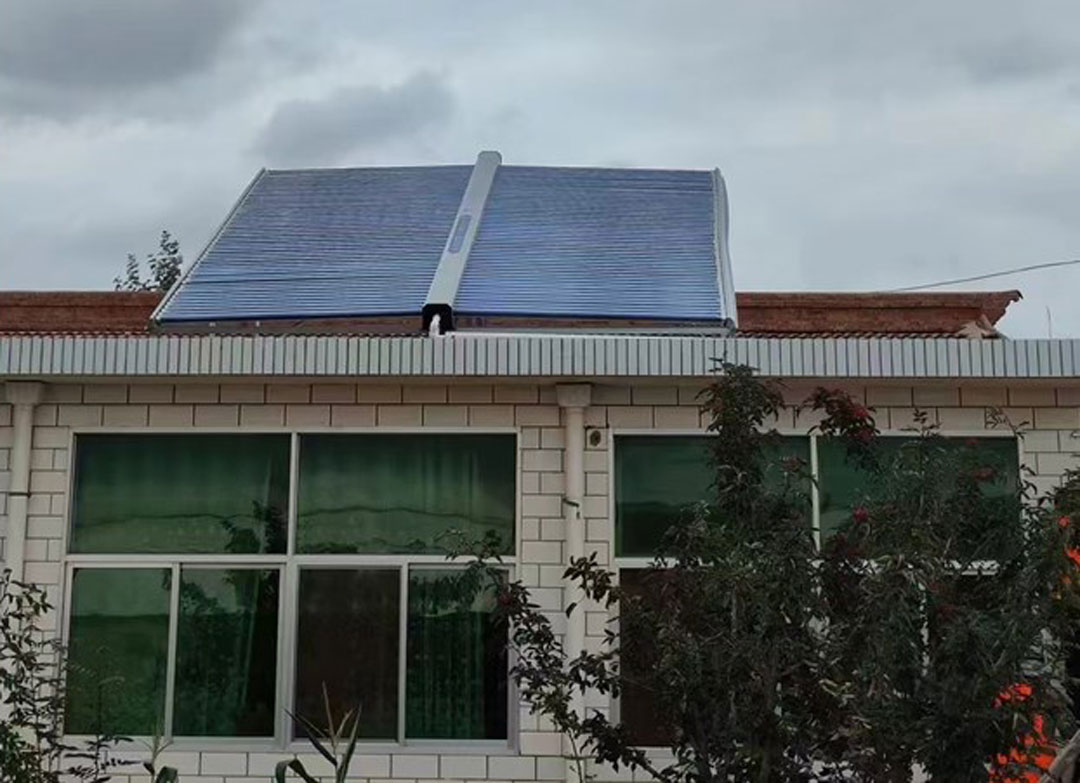
As a key livelihood project in Yongdeng County, the initiative covered remote villages across multiple towns. Preliminary surveys revealed that most rural houses were self-built with an area of 50-60㎡, featuring simple thermal insulation. Scattered coal heating not only failed to maintain stable indoor temperatures but also posed safety risks. After demonstration and testing, SOLETKS’s manifold vacuum tube collectors were selected as the core equipment, and a standardized clean heating solution was customized for each household to balance heating needs, economy, and safety.
For houses of 50-60㎡, the project uniformly configured a system of "1 set of 100 SOLETKS manifold vacuum tube collectors + 400L hot water storage tank + 2KW water-electric dual-purpose fan," forming a heating mode of "solar energy as the main source, electric energy as supplementary." SOLETKS’s collectors were precisely adapted to Yongdeng’s winter climate: the vacuum tubes, made of borosilicate 3.3 glass and treated with low-temperature strengthening, could withstand temperatures as low as -30°C, solving the problem of equipment freezing and cracking in northern regions; the independently developed nano-selective absorption coating achieved over 95% solar absorption rate and less than 5% thermal emission rate, ensuring efficient heat collection even under low-temperature and weak-light conditions; the manifold adopted food-grade 304 stainless steel flow channels, improving heat transfer efficiency by 12% compared to industry averages; the outer shell, made of thickened galvanized steel with electrostatic spraying, resisted corrosion and sand, boasting a design lifespan of over 15 years and reducing maintenance costs.
The 400L hot water storage tank used a double-layer stainless steel inner tank and polyurethane foam insulation, maintaining heat for over 24 hours to ensure heating during nights and cloudy days. The 2KW fan could automatically switch to electric heating for supplementary heat and distribute heat evenly to avoid cold spots. Additionally, SOLETKS provided a customized intelligent control system that monitored and adjusted equipment in real time, allowing villagers to enjoy stable heating without manual operation—an especially user-friendly feature for the elderly in rural areas.
In practical operation, the system maintained a stable indoor temperature of 18±2°C, meeting national heating standards and ending the dilemma of "burning coal during the day and enduring cold at night." Villager Uncle Wang commented, "Burning coal used to be tiring and left the house cold. Now with SOLETKS’s solar heating, the house stays warm, and it’s so hassle-free." The economic and environmental benefits were equally notable: traditional scattered coal heating consumed 2 tons of coal per household annually, costing nearly 2,000 yuan. In contrast, the new system only required 300-500 yuan in annual electricity fees, reducing costs by over 70%. After 3,500 households switched to clean heating, the project cut scattered coal consumption by 7,000 tons, carbon dioxide emissions by 18,000 tons, and sulfur dioxide emissions by 56 tons annually, improving Yongdeng’s winter air quality.
This project serves as a model for integrating livelihood initiatives with energy transformation. Leveraging SOLETKS’s technological advantages, it addresses the challenges of "high cost, difficult promotion, and poor cold resistance" in rural clean heating, providing a replicable example for northern rural areas. Today, SOLETKS’s collectors on the roofs of Yongdeng’s villages have become a green landscape. In the future, as the project advances and SOLETKS’s technologies upgrade, more rural households will benefit from clean heating, injecting green momentum into rural revitalization.