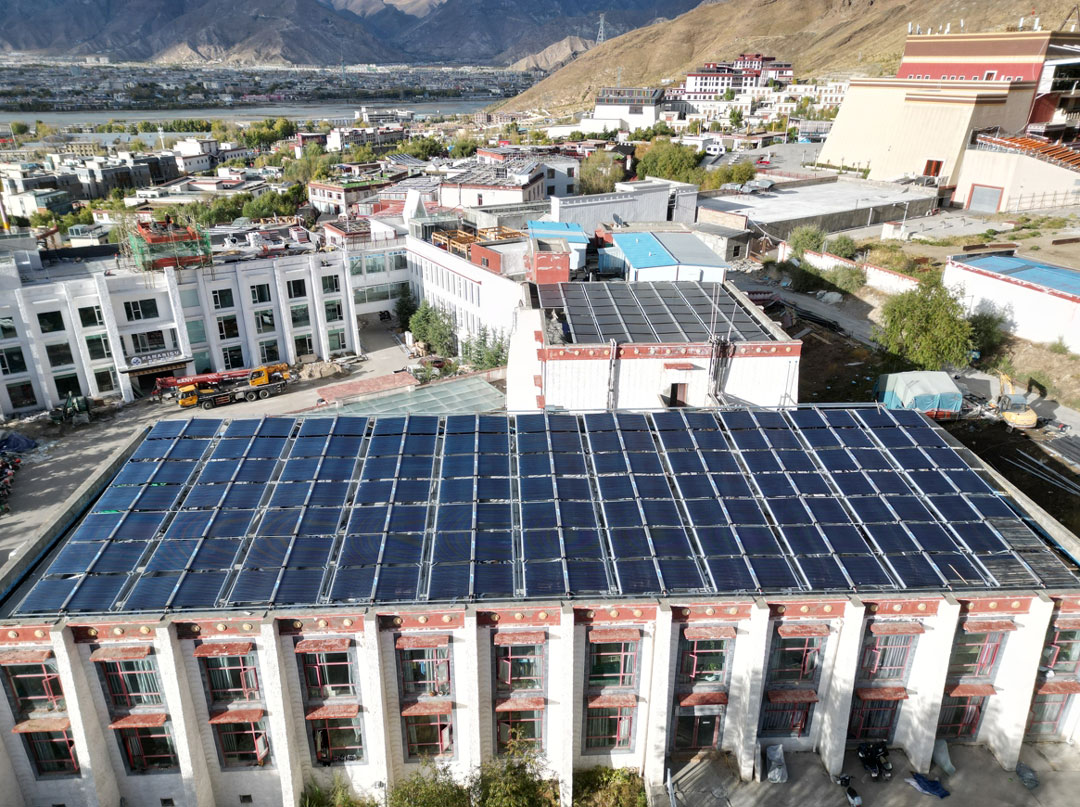
High-Altitude Solar Hot Water Case: 40T/Day Resort in Lhasa

2025/09/12 17:51


Scenic Resort    Lhasa, Tibet    High-Altitude 3,650m    40 T/Day

40-Ton/Day Solar Hot Water System for a Plateau Scenic Resort in Lhasa, Tibet

77 sets of 100-tube manifold collectors deliver 40 tons of 55–60°C hot water daily at 3,650 m altitude, replacing electric heating across 200+ guest rooms — CNY 280k saved annually, 350 tons CO₂ cut, complaints down 90%+.

Location    Lhasa, Tibet, China (3,650m)
Application    Tourist Resort & Hotel Complex
System Type    100-Tube Manifold Vacuum Tube Collector
Capacity    40 Tons / Day @ 55–60°C
Collector Quantity    77 Sets (Feitian New Energy)
Coverage    200+ Rooms, 3 F&B Areas, 2 Public Baths

Project Background

The Princess Wencheng Star Domain is a flagship scenic resort outside Lhasa, combining Tibetan cultural performance, plateau astronomy tourism, and hospitality. With sustained high visitor volume, hot water demand spans guest rooms, restaurants, and public bath facilities. The resort previously relied on electric heating, which is expensive to operate at scale and conflicts directly with Tibet's ecological protection policy framework.

Why this case matters for similar high-altitude projects: Lhasa offers 3,000+ sunshine hours annually and solar radiation far above lowland averages — but standard collectors fail rapidly under -10°C winter lows, 15–20°C daily temperature swings, and intensified UV from thin atmosphere. This project demonstrates the engineering envelope required for plateau-rated solar thermal: cold tolerance, anti-freeze logic, and UV-stable selective coatings.

The Challenges Before Retrofit

The resort's hot water problem was not just cost — it was reliability under conditions that break commodity solar equipment. Four specific constraints shaped the design.

High electric heating cost

Electric water heating for 40 t/day at a 200+ room resort generated annual electricity bills near CNY 300k+. The cost scaled with peak season occupancy, with no upside ceiling.

Equipment failure at altitude

Standard solar collectors crack under -30°C freeze-thaw cycles, lose absorption efficiency under high UV, and degrade aesthetically — all unacceptable for a scenic resort with visible rooftop installations.

Guest complaints on hot water

Traditional heating produced long wait times and temperature swings, particularly during evening peak in winter. Hot water complaints were a recurring service issue across 200+ rooms.

Ecological & policy pressure

Tibet's "tourism + ecology" policy framework requires visible carbon reduction action from scenic operators. Continued reliance on grid electricity for thermal loads created both reporting risk and brand inconsistency.

Solution Overview

SOLETKS partnered with the resort and deployed 77 sets of 100-tube manifold collectors engineered by Feitian New Energy (a SOLETKS Group subsidiary specializing in plateau and engineering-grade collectors). The design philosophy centers on three principles: redundancy through quantity, plateau-specific material specification, and unified control across the 77-set array.

Modular 77-set array, not a monolithic block

Distributing the 40 t/day load across 77 manifold sets allows partial-load operation, simplifies maintenance (single-set isolation without system shutdown), and gives the rooftop visual integration with the scenic environment.

Plateau-rated materials throughout

1.8mm borosilicate 3.3 vacuum tubes survive -30°C freeze-thaw testing. 304 stainless steel manifold shells with UV-resistant coating deliver 15+ year service life under high-altitude UV exposure.

High-absorption selective coating

Proprietary coating achieves 96% solar absorption with under 4% heat emission. UV stability ensures performance does not degrade over years of high-altitude exposure — a primary failure mode for commodity collectors at this elevation.

Intelligent anti-freeze circulation

All 77 sets linked under unified control. Anti-freeze circulation activates automatically below 5°C ambient temperature, protecting the pipe network during overnight lows that routinely hit -10°C in Lhasa winter.

System Configuration

Solar Collectors      100-Tube Manifold × 77 sets

Feitian New Energy engineering-grade manifold collectors. 1.8mm borosilicate 3.3 vacuum tubes, 96%/4% absorption-emission ratio, 304 stainless steel shell with UV coating.

Daily Output      40 tons @ 55–60°C

Stable delivery temperature year-round across 200+ guest rooms, 3 catering zones, and 2 public bath facilities. Instant hot water delivery eliminates legacy wait-time complaints.

Freeze Protection      Active at <5°C ambient

Unified intelligent control across all 77 sets. Anti-freeze circulation triggers automatically, validated against -30°C freeze-thaw cycles. Critical for -10°C Lhasa winter overnight lows.

Service Life      15+ Years

304 stainless steel manifold shell with UV-resistant coating engineered for high-altitude UV exposure. Modular layout allows individual set replacement without system shutdown.

Before vs After

The table compares the resort's hot water system under the previous electric heating baseline versus the deployed 77-set solar thermal array. Cost and emissions data are operator-reported.

MetricElectric BaselineSolar Thermal (77-Set Array)Improvement
Daily hot water output40 tons (intermittent)40 tons (stable, 55–60°C)Stability resolved
Annual electricity cost~CNY 300k+Backup-only consumption~CNY 280k saved/yr
15-year operating savingCNY 4M+ cumulative
Annual CO₂ emission~350+ tCO₂Near zero (solar-led)350 t reduced/yr
Annual SO₂ emission~11 t (equivalent)Eliminated11 t reduced/yr
Standard coal equivalent~140 t/yr140 t saved/yr
Guest hot water complaintsRecurring (peak winter)Reduced significantly90%+ ↓

Performance Results

Operator-reported annual performance after commissioning. The 15-year cumulative savings figure is based on stable electricity tariff projection and observed first-year operating data.

CNY 280k    Annual Saving    vs. electric heating baseline
350 t    CO₂ Reduced / Year    Equivalent to 19,000 trees
90%+    Complaint Reduction    Operator-reported
CNY 4M+    15-Year Saving    Cumulative vs. baseline

"Hot water stability improved significantly — guest complaints dropped by over 90%. Annual electricity savings reach 280,000 yuan compared to traditional electric heating, and over 4 million yuan is projected across 15 years of operation."

— Operations Director, Princess Wencheng Star Domain

Planning a solar hot water project at high altitude or in an extreme climate? Get a sized quote within 24 hours.

Request a Quote →

Engineering Takeaways for High-Altitude Projects

Lessons from this deployment apply directly to any hospitality, scenic, or institutional project above 2,500 m, or in regions with similar UV intensity and winter freeze profiles.

Specify plateau-rated tubes, not commodity

1.8mm borosilicate 3.3 with documented -30°C freeze-thaw test data is non-negotiable above 3,000 m. Commodity collectors fail within 2–3 winters under this thermal cycling, eliminating any payback advantage.

UV-stable selective coating matters more than peak absorption

At 3,650 m, UV intensity accelerates coating degradation by 3–5x versus lowland conditions. Long-term performance retention beats marginal absorption gains. Verify coating UV stability spec, not just initial efficiency.

Modular array beats centralized block

77 individual manifold sets allow maintenance without system shutdown — critical for hospitality where hot water cannot go offline. Single-block designs force scheduled downtime that resort operations cannot accept.

Anti-freeze logic must be automatic

Manual anti-freeze protocols fail during overnight unattended periods. Unified control activating below 5°C ambient is the only reliable solution for -10°C winter environments — and the cost difference vs. manual systems is negligible at this project scale.

FAQ

Can solar hot water systems really operate reliably at 3,650 m altitude?

Yes, with the correct specification. Lhasa receives 3,000+ sunshine hours annually and solar radiation well above lowland averages, making it one of the strongest solar resource zones in China. The constraint is equipment durability, not solar availability — which is why this project uses 1.8mm borosilicate 3.3 tubes and UV-stable coatings rather than commodity components.

What is the payback period for a project this size?

With annual savings around CNY 280,000 against an electric heating baseline, payback typically falls within 5–8 years depending on initial CAPEX, after which the system delivers near-pure savings for the remainder of its 15+ year service life.

How is hot water supplied on cloudy days or during winter peak?

The 77-set array stores heat in insulated tanks throughout the day. Backup electric heating activates only when stored heat is insufficient, dramatically reducing total electricity consumption compared to baseline electric-only systems.

Can this design be replicated in other high-altitude regions outside Tibet?

Yes. The same engineering envelope applies to Andean (Bolivia, Peru), Himalayan (Nepal, Bhutan), and high-elevation Central Asian sites with similar UV intensity and winter freeze profiles. SOLETKS supplies plateau-rated systems for export under OEM and turnkey arrangements.

What is the maintenance requirement for 77 collector sets?

The modular design allows isolation of individual sets for inspection or replacement without shutting down the system. Annual maintenance includes coating inspection, pump and controller check, anti-freeze fluid verification, and tube condition review. Typical effort is one quarterly site visit by a trained technician.

Build a Plateau-Rated Solar Hot Water System

SOLETKS and its Feitian New Energy subsidiary engineer solar thermal systems for high-altitude, extreme-climate, and large-scale hospitality projects — exported to 60+ countries.

     Sized quote within 24 hours
     Plateau and extreme-climate engineering experience
     Turnkey EPC support: design, supply, commissioning
     15+ year service life, OEM available