Chinese
 Español
 Francés
 Deutsch
 Русский
 العربية
 Português
 日本語
 한국어
 Italiano

Solar Water Heating for Camps and Field Facilities
Solar Water Heating for Camps and Field Facilities
A fuel-saving domestic hot water layer for showers, kitchens and laundry — sized from people × litres × ΔT, with full backup, storage and freeze protection for remote reliability.
This article addresses the engineering of hot water service for non-combat camps and field facilities — humanitarian bases, construction camps, mining camps, disaster relief shelters, peacekeeping accommodation, remote research stations, and barracks-style staff housing. It does not address tactical or operational deployment of equipment.
Short Answer
Quick Verdict
Solar water heating for camps and field facilities is best designed as a fuel-saving domestic hot water layer for showers, kitchens, laundry preheat, and hygiene service water. It should never be treated as the only heat source. A reliable camp system still needs backup heat, sized storage, freeze protection, pressure safety, and a defined service plan — because remote downtime is far more expensive than equivalent downtime in an urban hotel.
For planning, calculate the daily hot water load first. A 120-person camp using 25 L/person/day and heating water from 12 °C to 45 °C needs about 115.1 kWh/day of useful heat before losses. If solar supplies 50% of that heat and useful collector yield is 2.0 kWh/m²/day, the first-pass collector area is about 28.8 m² before climate, dust, and pipe-loss derating.
For Soletks system paths, compare the commercial solar hot water system page, the solar water heater category, the evacuated tube solar collector category, and the cold-region / winter performance guide. The deeper commercial sizing methodology covers solar fraction and storage logic. Sizing inquiries can be submitted through the Soletks contact page.
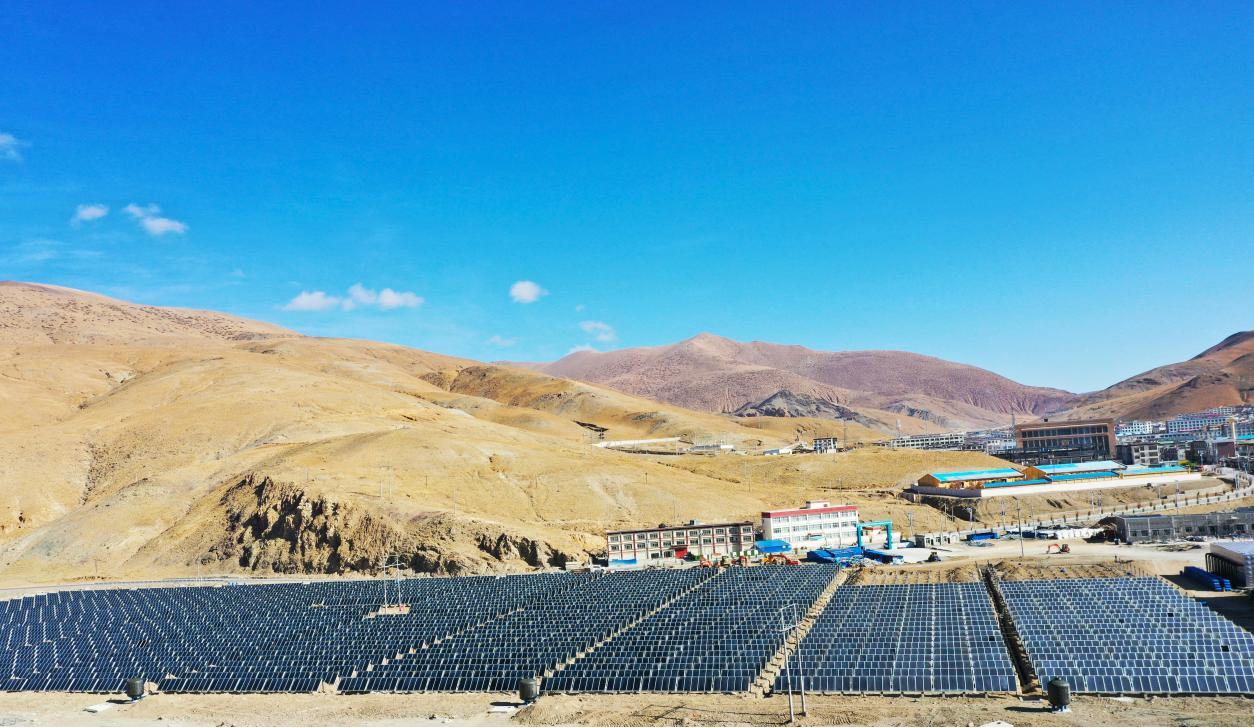
Remote-site durability reference
Shigatse is useful here because it proves fixed arrays can survive high-altitude remote conditions.
The project now supports the reliability argument: cold, UV, altitude and service access matter as much as the daily heat calculation.
Best-Fit Uses
The best uses are predictable daily hot water loads that reduce fuel, generator runtime, or electric resistance heating. Solar thermal works well when hot water is needed most days and storage can shift daytime heat into evening shower peaks. It works poorly when the camp has very irregular occupancy, no on-site maintenance staff, no storage space, or a mission profile that requires frequent relocation without modular equipment.
The temperature ranges below are screening values for domestic hot water and service-water planning; final limits depend on local hygiene rules, mixing valves, and equipment requirements.[1]
| Load | Typical target temperature | Solar fit | Design note |
|---|---|---|---|
| Shower blocks | 40–45 °C at point of use | Strong | Needs storage and thermostatic mixing valves |
| Kitchen pre-rinse | 45–60 °C | Good | Backup raises final dishwashing temperature |
| Laundry preheat | 40–60 °C | Good | Batch schedule shapes storage sizing |
| Medical / hygiene support | 45–60 °C | Preheat only | Stricter hygiene rules may apply |
| Equipment wash water | 35–55 °C | Project-specific | Water quality and runoff rules matter |
| Space heating support | 30–45 °C | Limited | Depends on emitter type and climate |
The strongest single use case in almost every camp is the shower block, because shower demand is concentrated in the evening — exactly when a well-sized tank can release the daytime solar heat without needing the boiler at all. This is the same demand profile that makes dormitory and student-housing systems economically attractive in commercial buildings.[2]
Load Calculation Example
Camp hot water sizing should begin with people, litres per person, and temperature rise — never with a tube or panel count. The screening formula below uses standard water properties (cp ≈ 4.186 kJ/(kg·K), ρ ≈ 1 kg/L). Dividing by 3600 gives the convenient constant 0.001163 kWh per (L·K).[1]
Daily heat demand (kWh/day)
  = Daily hot water volume (L) × Temperature rise (K) × 0.001163

Derivation:
  0.001163 ≈ (1 kg/L × 4.186 kJ/(kg·K)) ÷ 3600 s/h
           ≈ 0.001163 kWh / (L·K)
| Input | Value |
|---|---|
| Personnel | 120 people |
| Hot water use | 25 L/person/day |
| Daily volume | 3,000 L/day |
| Cold-water inlet | 12 °C |
| Shower / service water target | 45 °C |
| Temperature rise (ΔT) | 33 K |
| Useful heat demand | 115.1 kWh/day |
| Solar contribution target (50%) | 57.6 kWh/day |
| Useful collector yield (screening) | 2.0 kWh/m²/day |
| Required aperture (screening) | 28.8 m² |
The recommended next step is to screen the system around 30–45 m² aperture after derating for season, dust accumulation, pipe heat loss, storage loss, and reliability of backup supply. The same Soletks methodology used for hotel and dormitory projects produces the same formula — only the per-user demand and reliability premium change.[2]
In one representative Soletks field-facility RFQ, the buyer supplied a measured 120-person camp occupancy and a 3,000 L/day shower-water estimate. The 115.1 kWh/day load made the technical review concrete: roughly 8 × Soletks EFPC-class flat plate modules (~4 m² aperture each), a 3,000 L stratified storage tank, and a 30 kW electric backup heater sized to cover full peak demand on cloudy days — far more useful than "solar heaters for camp use."[1]
Collector Choice
Collector choice depends on climate, mobility, target temperature, and service access. The matrix below is a screening tool; final selection requires local weather, installation structure, storage layout, and a written service plan.[1]
| Option | Best fit | Service life / inspection | Strength | Limitation |
|---|---|---|---|---|
| Soletks flat plate (EFPC / AFPC) | Warm, temperate, high-altitude fixed camps | 15–25 yr; annual | Robust, simple, large modular arrays | Lower winter performance in cold wind |
| Heat pipe evacuated tube (HPC) | Cold or higher-temperature sites | 15+ yr; annual | Better retention, fast morning start | Tube handling, min. 20°–25° tilt |
| U-tube evacuated tube | Closed-loop commercial / high-altitude | 10–20 yr; annual | Tolerates higher operating temperature | More installation discipline |
| Split pressurised system | Permanent barracks or base accommodation | 10–20 yr; annual | Indoor tank, pressurised control | Needs plant room |
| Compact thermosiphon | Small low-complexity outposts | 5–15 yr; seasonal | Minimal controls, no pumps | Limited capacity, hard to scale |
| Mobile / containerised skid | Temporary or relocatable sites | Pre/post deployment inspection | Faster mobilisation | Needs frame + quick connections |
The mechanism is practical. Flat plate collectors are mechanically simple and survive rough handling — the Soletks EFPC large-format flat plate has already been deployed at 107,000 m² scale in Shigatse, Tibet, at over 4,000 m altitude, replacing coal and yak-dung heating and cutting 2,424 tonnes of coal per year. That field record matters more than a brochure spec sheet when the project is a remote camp. Heat pipe evacuated tubes (the Soletks HPC series with 0.6 MPa working pressure and 0.724 peak efficiency) become the better answer when winter ambient drops below freezing or when the target temperature is above 55 °C.
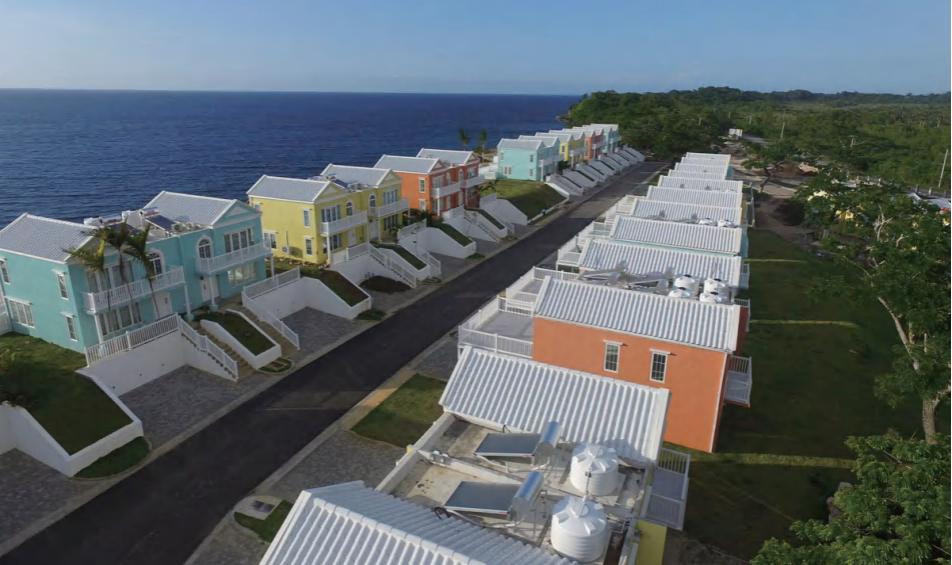
Distributed block template
Florida Resort is the right analogy for barracks-style accommodation blocks.
Each unit carries its own array, which keeps pipe runs short and makes maintenance isolation simpler than one oversized central loop.
Storage, Backup and Reliability
A camp system should use solar as a preheat layer and backup heat as the reliability layer. This is the single most important design rule for remote facilities. It prevents cold showers when weather, dust, shading, or a sudden occupancy spike reduces solar output.[1]
| Design item | Practical starting point | Reason |
|---|---|---|
| Storage volume | 0.8 – 1.2 × daily use | Covers evening peaks and morning ramp-up |
| Backup heater capacity | 100% of peak demand | Covers night, storms, and dust periods |
| Solar fraction (annual) | 30–60% | Balances fuel saving against reliability |
| Freeze protection | Glycol / drainback | Exposed piping freezes even with dry tubes |
| Dust cleaning interval | 1–4 weeks (dusty regions) | Dust on glass directly cuts solar input |
| Inspection interval | Monthly + annual service | Reduces field-failure risk |
Hygiene rule: for medical clinics or food preparation, the backup heater should be the final temperature authority for any anti-Legionella regime. Solar preheats the water; the backup boiler or electric heater delivers the regulated final temperature and thermal-disinfection cycle.
For the 120-person example above, a 3,000 L storage tank (1.0 × daily volume) is a clean starting point — large enough to absorb the full daily solar yield, small enough to keep tank standing-loss reasonable. The backup heater should still be sized for the full peak load, because the design goal is fuel saving, not fuel elimination. For cold-region camps, closed glycol loops and drainback systems are the two practical freeze answers — see the Soletks cold-region solar water heater guide.
Standards and Documents to Request
The proposal should include collector testing, pressure safety, potable-water compatibility, and control documentation — not just a price list and a render.
| Standard or document | Applies to | Buyer action |
|---|---|---|
| ISO 9806:2017 | Solar collector thermal performance | Request test data and conditions — ISO 9806 |
| Solar Keymark | European certification scheme (ISO/EN based) | Match to incentive or tender requirement |
| EN 12975 | Legacy European collector reference | Use when tender still names EN 12975 |
| EN 12976 | Factory-made solar thermal system reference | Use for packaged-system tender language |
| NSF/ANSI 61 | Drinking-water contact materials | Apply to potable-water contact components |
| ASTM D3306 | Glycol coolant cross-reference | ASTM D3306 for indirect glycol loops |
| ASME BPVC Section VIII | Pressure vessel reference | Apply where tanks/HX fall under pressure rules |
| ISO 9001 / 14001 / 45001 | Quality, environment, occupational health | Soletks holds all three; request with the tender pack |
For collector test references, anchor the RFQ to ISO 9806 + Solar Keymark. NSF/ANSI 61 applies only when potable water touches the collector loop directly; in indirect glycol designs (which most camp installations are) the standard applies to the heat exchanger and tank rather than the collector.
Deployment and Maintenance Matrix
Field facilities need simple, well-documented service tasks because remote downtime is expensive. The intervals below are screening values; final plans depend on dust, water quality, logistics, and site staffing.[1]
| Task | Suggested interval | Why it matters |
|---|---|---|
| Collector glass / tube cleaning | 1–4 weeks (dusty sites) | Dust on glazing directly cuts solar input |
| Pump and controller inspection | Monthly | Catches circulation failure before tank cool-down |
| Glycol pH and freeze-point check | 1–2 times/year | Propylene glycol degrades thermally over time |
| Safety valve and expansion check | Annual | Prevents pressure incidents |
| Tank sediment inspection | 6–12 months | Water hardness shortens tank life |
| Spare tube, gasket, sensor stock | Project-specific | Shortens repair time when shipping is slow |
| Anode rod inspection (steel tanks) | Annual | Extends storage tank life in hard-water sites |
The best procurement plan includes spare parts, installation drawings, and a written service routine before shipment — not after the first failure. For containerised or skid-mounted designs, packing also matters: the same Soletks logistics frames used for European shipments help control freight cost and reduce site damage.
Soletks Reference Projects
Real Soletks reference installations show what scale, climate, and reliability look like for camp-style hot water service. These are existing, documented projects — the closest published analogues to a camp or remote facility deployment.
Shigatse centralised heating
107,000 m² collector area. Replaced coal and yak-dung heating, removed 2,424 t/yr coal. Proves EFPC flat plate survival at extreme altitude.
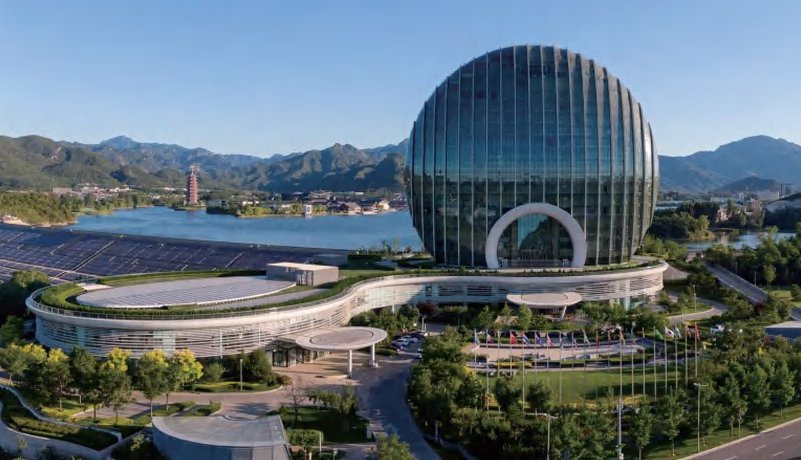
APEC Summit Hotel
High-reliability hot water at a politically critical site. 150,000 kWh/yr saved, 74 t CO₂ avoided. Closest urban analogue to a high-reliability camp shower system.
Florida Resort villas
Distributed flat-plate water heaters per unit. Useful template for distributed barracks-block hot water where each block has its own array.
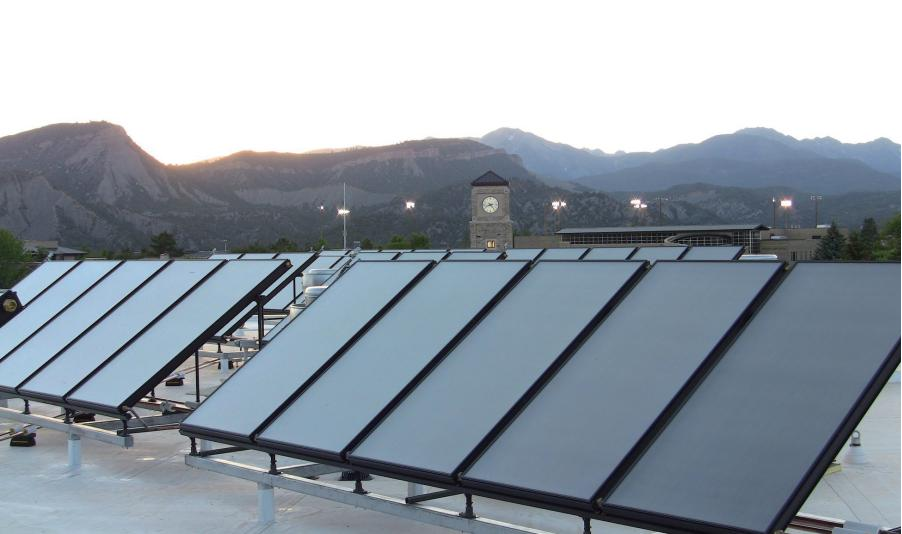
Harz Church hot water
Engineering-grade collectors in series/parallel in a temperate European climate. Closest analogue to a 100–300 person European camp.
These four references span the relevant design space: high-altitude cold, urban high-reliability, distributed per-unit, and temperate European mid-scale. A camp RFQ can reasonably be benchmarked against the closest of these four rather than starting from a blank page.
RFQ Inputs for Soletks
A strong RFQ describes the camp load and the reliability requirement, not just an area number.
Include the following in your inquiry
For engineering support, send the RFQ data through the Soletks contact page and request a camp hot water sizing analysis. A useful reply should show daily heat demand in kWh/day, collector aperture in m², module model and quantity, tank size, backup capacity, freeze-protection method, and recommended service plan — all in the same table.
Specification Checklist
| Specification item | Minimum value to include | Why it matters |
|---|---|---|
| Daily hot water load | L/day and user count | Sets heat demand |
| Target temperature | °C (point of use and storage) | Defines useful heat |
| Collector area | m² gross and aperture | Supports honest output comparison |
| Storage volume | Tank litres + stratification design | Shifts daytime solar to evening peak |
| Backup capacity | kW and fuel | Covers cloudy days, night, dust events |
| Freeze method | Glycol, drainback, or protected route | Protects exposed loops |
| Dust and cleaning plan | Interval, access, water source | Maintains output in arid regions |
| Mobility requirement | Fixed, skid, or container | Affects frame and piping design |
| Spare parts | Tubes, gaskets, pumps, sensors, anodes | Reduces downtime |
| Documents | Drawings, manuals, warranty, certifications | Supports deployment and audit |
Quick Calculator
Three lines to estimate daily heat demand for any camp or field-facility RFQ:
Step 1   Read or specify:  N people, V_pp (L/person/day), T_cold (°C), T_target (°C)
Step 2   ΔT = T_target − T_cold ; V_total = N × V_pp
Step 3   Daily heat (kWh) = V_total × ΔT × 0.001163
Worked check for a 300-person construction camp at 15 °C → 50 °C with 30 L/person/day: 9,000 × 35 × 0.001163 ≈ 366.4 kWh/day. At 50% solar fraction and 2.0 kWh/m²/day useful yield, that points to roughly 92 m² of aperture — a recognisable European mid-scale flat plate array. If a supplier's quotation cannot be reverse-checked with this formula within ±15%, ask for the assumed solar fraction and irradiation in writing.
Size your camp hot water properly
Send user count, daily volume, target temperature, climate and mobility requirement. Soletks returns heat demand, aperture, module count, tank size, backup capacity and service plan in one table.
FAQ
Q1.Is solar water heating practical for camps and field facilities?
Q2.How much hot water does a field camp need?
Q3.Which collector type is best for a camp?
Q4.Does a camp solar water heater still need a backup boiler?
Q5.How is freeze protection done in a cold-region camp?
Q6.What information does Soletks need for a camp quotation?
Key Takeaways
Remember these five
Size from people × litres × ΔT × 0.001163 first, then translate into aperture and module count — never the reverse.
A camp system is always solar + backup, never solar alone. Backup should cover 100% of peak load; solar provides 30–60% of annual energy.
Storage volume around 1.0 × daily hot water use is a clean starting point for shower-heavy camps; stratified tanks help shift daytime heat into evening peaks.
Freeze protection is a system property, not a collector property. Closed glycol or drainback are the two valid answers in freezing climates.
Soletks has documented references at 107,000 m² (Tibet), 50 t/day (APEC Beijing), 22 t/day (Harz, Germany), and per-villa scale (Florida). Benchmark a camp RFQ against the closest of those four.
Sources
Authority references used in this article include ISO 9806:2017 solar collector performance testing, Solar Keymark certification scheme, EN 12975 and EN 12976 legacy and packaged-system references, NSF/ANSI 61 for potable-water contact materials, ASTM D3306 for glycol coolant cross-reference, ASME BPVC Section VIII for pressure vessel rules, and ISO 9001 / ISO 14001 / ISO 45001 management-system standards (all held by Soletks). Soletks reference project data — Shigatse 107,000 m² (2019), APEC Summit Hotel Beijing 50 t/day (2014), Florida Resort villas 200 L/day (2022), and Harz Church Germany 22 t/day (2021) — are taken from the Soletks corporate project portfolio. Commercial sizing methodology cross-references the Soletks commercial hot water sizing guide.
Screening calculations and maintenance intervals in this article are for early RFQ planning. The 0.001163 constant is derived as (1 kg/L × 4.186 kJ/(kg·K)) ÷ 3600 ≈ 0.001163 kWh/(L·K). Final system sizing should use local climate data, project schedule, current product datasheets, water quality, installation layout, and backup heater requirements.
Commercial sizing methodology follows the same workflow used for hotel, hospital, dormitory, and factory projects: define application → estimate demand → confirm temperature rise → choose solar fraction → select collector → size aperture → size storage and backup.