Chinese
 Español
 Francés
 Deutsch
 Русский
 العربية
 Português
 日本語
 한국어
 Italiano

Solar Storage Tank Sizing for Commercial Systems: L/m², Preheat Tanks and Multi-Tank Layouts
Solar Storage Tank Sizing for Commercial Systems: L/m², Preheat Tanks and Multi-Tank Layouts
Start at 60–80 L per m² of collector, then check it against a clear day's solar heat, the building's load profile and the plant room.
For most commercial solar hot water systems, start with about 60–80 liters of storage per m² of collector. Then check that value against the daily heat the collectors can produce, the building's load profile, and the space available in the plant room.
Sizing commercial solar hot water storage is a balance. A tank that is too small runs hot, lowers collector efficiency and can lead to stagnation. A tank that is too large costs more and loses more heat, often without a meaningful gain in solar output.
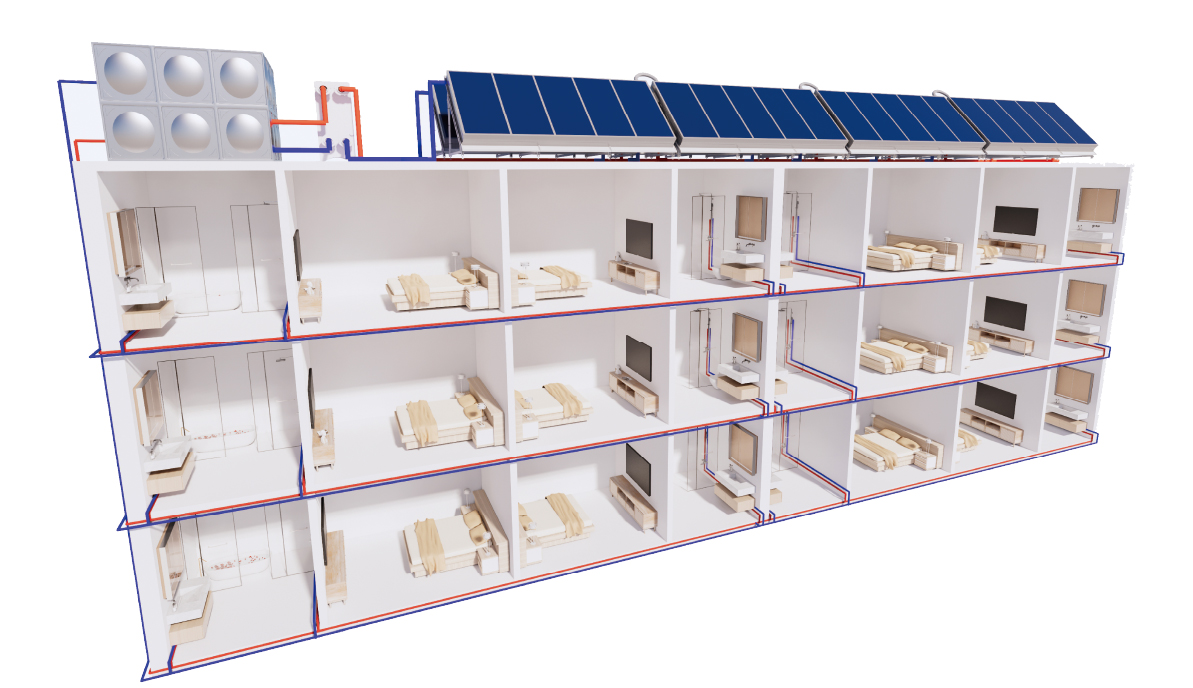
Quick steps for sizing solar storage tanks
1Calculate daily hot water demand and heat demand.
2Choose a target solar fraction and collector area.
3Multiply collector area by 60–80 L/m².
4Check that the tank can store a clear day's solar heat.
5Adjust for load timing, weekends and seasonal closures.
6Choose a tank layout that fits the plant room and maintains stratification.
The L/m² rule and where it comes from
The 2002 edition of the US military's UFC 3-440-01 design criteria, since superseded by a 2015 edition, gives a clear statement of the common rule: 1.5–2 gallons per ft² of collector, equal to 61.1–81.5 L/m². It says larger tanks do not significantly increase system performance, while smaller tanks can reduce performance by raising storage temperature and lowering collector efficiency.
Within this range, the exact size is not critical, so choose a standard tank size that fits. Other published guidance points the same way, although methods based on one clear day's output give lower figures:
| Source | Published ratio | Approximate metric equivalent |
|---|---|---|
| UFC 3-440-01 (2002 edition) | 1.5–2 gal/ft² | 61–81 L/m² |
| US DOE consumer guidance (archived) | Typically 1.5 gal/ft², up to 2 in very warm, sunny climates | 61–81 L/m² |
| SOLETKS sizing guide | 50–80 L/m² | 50–80 L/m² |
| SunEarth calculation | 1.05 gal/ft² (Boston) to 1.45 gal/ft² (Florida) | 43–59 L/m² |
SunEarth's figures are lower because its method assumes a modest clear-day output of about 3.15 kWh/m² and heats the tank all the way to 71 °C, as explained below. SunEarth still calls the method conservative, because it assumes no hot water is drawn during the day; sites with large daytime draws can use less.
Why climate changes the answer
SunEarth's method estimates how much water a collector can heat on a clear day:
This gives gallons per ft², with mains temperature in °F. It assumes 1,000 BTU/ft² of clear-day collector output, or about 3.15 kWh/m². Its results convert to metric as follows:
| Mains water temperature | US result | Metric equivalent |
|---|---|---|
| 10 °C (50 °F) | 1.09 gal/ft² | 44 L/m² |
| 15 °C (59 °F) | 1.19 gal/ft² | 48 L/m² |
| 25 °C (77 °F) | 1.45 gal/ft² | 59 L/m² |
Warmer inlet water needs a larger volume to store the same energy, because each liter is heated through a smaller temperature rise up to the 160 °F (71 °C) limit in this method. Use your collector's real output and your own storage temperature limit for a more accurate result. In metric units:
Here, 0.001163 is the energy in kWh needed to heat one liter of water by 1 °C. With 3.5 kWh/m², 15 °C mains water and storage heated to 60 °C, as in the hotel example below, this gives about 67 L/m². With 5 kWh/m² and SunEarth's 71 °C limit, it gives about 77 L/m². Both fall inside the 60–80 L/m² range.
Worked example: 120-room hotel
This example continues the hotel in our commercial sizing guide.
Inputs
120 rooms at 75% occupancy, using 80 L per occupied room per day: 7,200 L
Laundry and kitchen: 4,000 L
Total demand: 11,200 L/day
Temperature rise from 15 °C to 55 °C: 40 °C
Solar share on a clear design day: 50% of the day's hot water heat
Useful collector output on a clear design day: 3.5 kWh/m² (a sunny-climate figure)
Step 1: Daily heat demand
Step 2: Collector area
Design day vs. annual solar fraction
Sizing on a clear design day keeps summer surplus small, and the existing backup covers the rest. Because 3.5 kWh/m² is a clear-day figure, not an annual average, the annual solar fraction will be well below 50%. Annual useful yields are more often 450–730 kWh/m² (see our guide to solar thermal system cost), so 75 m² would supply about 34–55 MWh of the hotel's roughly 190 MWh a year of hot water heat, or about 18–29%.
Step 3: Storage range
Step 4: Heat balance check
Choose 5,000 L (about 67 L/m²). Heating it from 15 °C to 60 °C stores:
This matches the array's output on the clear design day, about 261 kWh, so the tank can hold a full clear day's heat even with no daytime draw. This is the same logic as SunEarth's method above. On the sunniest summer days, output can reach about 5 kWh/m², or 375 kWh. Hot water drawn during the day and storage above 60 °C must absorb the difference, so check the summer overheating strategy.
Result: about 75 m² of collectors with 5,000 L of solar storage, subject to detailed simulation.
If you need a 50% annual solar fraction: higher solar fractions lower the yield per m², so assume about 450–650 kWh/m² a year. The array would grow to roughly 150–210 m², with about 9,000–17,000 L of storage at 60–80 L/m². That is about 0.8–1.5 times daily demand, so the gap to the 1.5–2× rule below narrows. Check a design like this by simulation, especially the summer surplus.
Need a storage check for your project?
Send daily hot water demand, peak times, temperatures and plant room dimensions, and SOLETKS can review your collector-to-storage ratio.
Why "1.5–2× daily demand" doesn't fit this hotel
In residential solar water heater tank sizing, you may also see a rule of 1.5–2 times daily hot water demand. It can work for a small residential system with a high solar fraction, where collector area and demand are closely matched.
For this hotel, it would give 16,800–22,400 L, or about 224–299 L/m². That is far beyond the normal range. On the clear design day, the array's 261 kWh would raise 16,800 L by only about 13 °C, from 15 °C to about 28 °C, so most of the tank would stay lukewarm.
The rule for commercial systems
So size commercial solar storage from solar heat production, then check it against demand. The existing backup system covers the remaining load.
Adjust for the load profile
Equal daily energy doesn't always mean equal storage. Ask when the hot water is used:
| Load pattern | Effect on storage |
|---|---|
| Steady daytime use, such as a laundry or process line | Heat is used as it is collected, so 50–60 L/m² may be enough |
| Evening peak, such as dormitories | Most solar heat must be held for hours, so stay in the middle to upper range |
| Morning peak, such as hotels | Heat must carry overnight, so insulation and stratification matter |
| Weekday-only use | Weekend heat has nowhere to go, so check extra storage against overheating protection |
| Seasonal closure, such as schools | Storage alone cannot solve this, so plan for stagnation or heat rejection |
Weekend and holiday shutdowns are often better handled by reducing the array or adding overheating protection than by buying a very large tank. See our guide to solar thermal overheating.
Choosing a tank layout
Solar preheat tank plus backup tank
This is a common choice for retrofits. Cold water enters the solar tank first, then passes to the existing boiler or water heater.
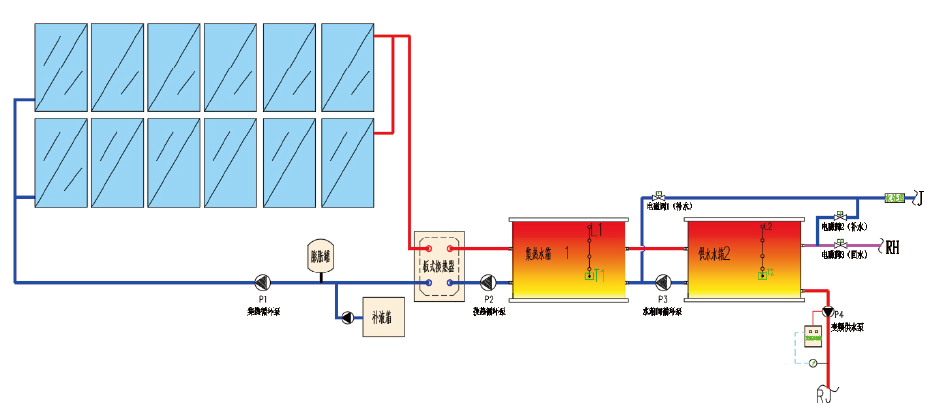
The key rule is to keep backup heat out of the solar tank where possible. Keeping the bottom of the tank cold lets the collector field run at a lower inlet temperature and start collecting earlier.
One large tank or several smaller tanks?
A single tank has less surface area for the same volume, so it usually loses less heat. The table below assumes vertical tanks with a height twice their diameter.
| Layout for 5,000 L | Approximate size of each tank | Total surface area | Compared with one tank |
|---|---|---|---|
| 1 × 5,000 L | Ø1.47 m × 2.94 m | 17.0 m² | — |
| 2 × 2,500 L | Ø1.17 m × 2.34 m | 21.4 m² | +26% |
| 4 × 1,250 L | Ø0.93 m × 1.85 m | 27.0 m² | +59% |
More surface area means more standby heat loss at the same insulation and temperature. Multiple tanks may still be the right choice when:
A single tank can't pass through doors or fit under the ceiling
The floor can't take the concentrated load (5,000 L of water alone weighs about 5 tonnes)
You need to keep part of the system running during maintenance
If you use several tanks, connecting them in series can help maintain a hot and cold section across the bank. Parallel tanks need careful balancing so each receives equal flow. UFC 3-440-01 also prefers vertical tanks for stratification and suggests horizontal tanks or a series of vertical tanks when space rules out one vertical tank.
Stratification
Stratification means keeping hot water at the top and colder water at the bottom. It improves solar performance because the collector receives colder water. To protect it:
Choose vertical tanks when space allows
Use low-velocity inlets or diffusers
Return collector heat at a suitable height, or use a stratification device
Avoid high-flow connections that mix the whole tank
Other design checks
Hygiene: preheat tanks can sit at temperatures where Legionella risk must be managed. Follow local rules and see our Legionella prevention guide.
Hard water: scale builds up faster at higher temperatures, so plan for treatment and cleaning access.
Corrosion: SunEarth notes that corrosion rates double with every 20 °F (about 11 °C) rise in temperature, so choose tank materials and temperature limits carefully.
Heat exchanger: an undersized exchanger can limit solar output even with the right tank. Size it for the field's peak output.
Insulation: check insulation on the tank, valves and connections, which can be a significant source of loss.
Space and structure: confirm floor load, access route, service clearance and replacement method.
Frequently asked questions
How many liters of storage do I need per m² of solar collector?
For commercial solar hot water, 60–80 L/m² is a common starting point. Our general sizing guide uses 50–80 L/m²; the lower end suits steady daytime loads, where heat is used as it is collected. Load profile, climate and temperature can move the final choice.
What happens if a solar storage tank is too small?
The tank heats up quickly, collector efficiency falls, and the system can reach its temperature limit and stagnate. Useful solar heat is then lost.
What happens if a solar storage tank is too large?
The tank costs more, loses more heat and takes more plant room space. It may also stay lukewarm, leaving more work for the backup system and increasing hygiene management needs.
Should the solar tank be separate from the backup tank?
Often, yes, especially on retrofits. A separate preheat tank keeps the solar tank cooler, which helps the collectors. The right choice depends on load, space and local hygiene rules.
Is one large tank better than several small tanks?
It usually loses less heat, because it has less surface area. Several tanks can still be better if access, floor loading or redundancy requires them.
Get a storage review for your project
Send SOLETKS your location, daily hot water demand, peak times, temperatures, available roof area and plant room dimensions through our contact page. We can review your collector and storage ratio for a commercial solar hot water system as part of your project proposal. For budgeting, see our guide to solar thermal system cost.
We review the collector and storage ratio as part of your project proposal.
Sources
How to size a solar water heater storage tank (SunEarth)