Chinese
 Español
 Francés
 Deutsch
 Русский
 العربية
 Português
 日本語
 한국어
 Italiano

Mains Pressure Solar Water Heater: Three Architectures Compared
Mains Pressure Solar Water Heater: Three Architectures Compared
"Pressurized" hides three different products — compact rooftop, split indoor-tank, and coil-tank indirect. Choosing the wrong one is the most expensive mistake at quotation stage. Here's the decision path.
Why One Word — "Pressurized" — Hides Three Products
A homeowner in Lisbon, a villa owner in Antalya, and a developer in Kuala Lumpur all type "mains pressure solar water heater" and assume they are searching for the same product. They are not. The first needs a compact 200–300L rooftop unit; the second needs a split system with the tank indoors for multi-storey supply; the third may need a coil-tank indirect design because of local water chemistry. Choosing the wrong architecture is the most expensive mistake at quotation stage.
Key Takeaways
The five decisions
"Mains pressure" means water is delivered at building supply pressure (typically 3–6 bar), not by gravity head — a fundamentally different product class from rooftop gravity-fed tanks.
Three architectures dominate: compact pressurized (tank on roof, ET-300 class, 7 bar), split pressurized (tank indoors with pump and closed loop, 300–1,000 L), and coil-tank indirect (internal heat exchanger separates collector loop from potable water).
A pressurized tank should be rated for at least 6 bar, ideally 7 bar. Soletks ET-300 and BTE-based split tanks are both rated 7 bar.
For multi-storey buildings, hard/aggressive water, or cold-climate freeze risk, split or coil-tank designs almost always outperform compact rooftop systems over 15 years.
A 200 L/day load heated 15 °C → 55 °C needs 9.30 kWh/day of useful heat and 2.2–4.0 m² of collector aperture depending on climate.
TL;DR
Quick Verdict
A mains pressure solar water heater should be selected by mains pressure (bar), tank location, roof load, freeze risk, water chemistry and service access. Compact suits simple roofs and moderate loads. Split suits villas, multi-storey homes and small commercial projects needing the tank indoors. Coil-tank indirect suits buyers wanting mains-pressure outlet water while keeping the collector loop isolated from drinking water.
For first sizing, 200 L/day heated from 15 °C to 55 °C needs 9.30 kWh/day before losses. At 60% solar contribution and a winter-weighted 2.5 kWh/(m²·day) yield, the field starts around 2.23 m² aperture before derating. After derating, plan for 2.5–4.0 m² ≈ 1–2 Soletks BTE-2.0-2 flat-plate collectors (1.87 m² aperture each).
For Soletks paths, compare the solar water heater product range, the integrated solar water heater (ET-150/200/300, 7 bar, enamelled tank, magnesium anode), the pressurized compact solar water heater guide, the cold-region / freeze performance guide, and the Soletks inquiry page.
Compact pressurized
Tank + collectors as one rooftop unit. 150–300 L, 7 bar (ET-300 class). Single-storey homes, mild climate. ~350 kg roof load with water.
Split pressurized
Roof collectors + indoor pressurized tank, closed glycol loop with pump & controller. 300–1,000 L, 7 bar. Multi-floor, cold-climate, retrofit.
Coil-tank indirect
Domestic water flows through internal copper/SS coil; tank water is the heat medium. Hard water, glycol loops, potable isolation.
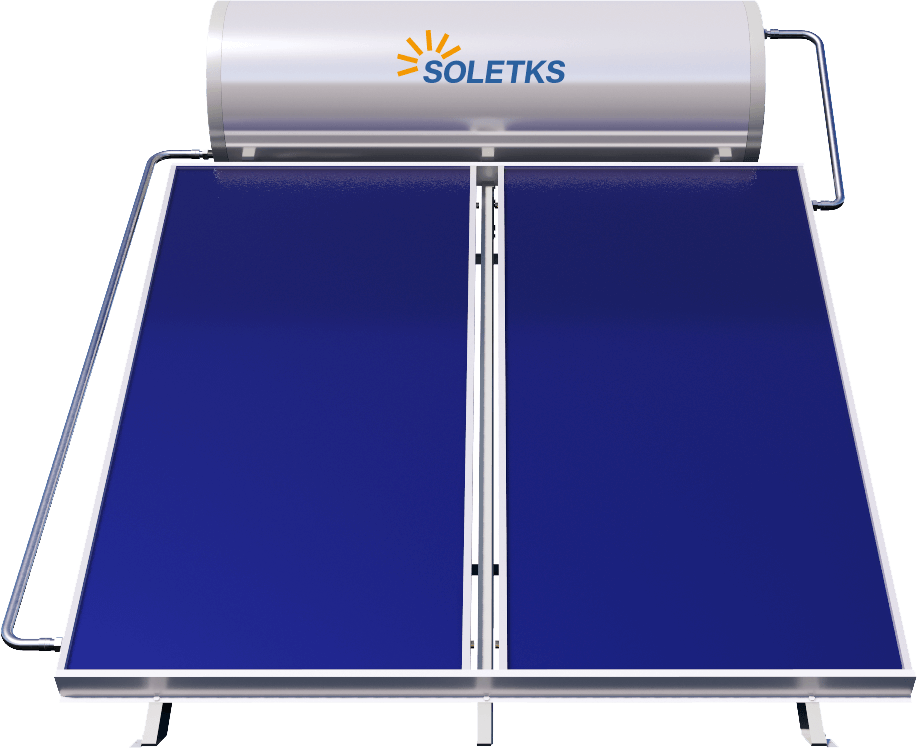
Architecture 1
ET-300 is the compact rooftop option when the roof can carry tank, water and frame as one package.
It gives mains-pressure delivery without a pump loop, but the buyer must check roof load, safety valve setting and summer stagnation behavior before ordering.
What "Mains Pressure" Actually Means
A mains pressure solar water heater delivers hot water at building supply pressure rather than from a gravity head. The buyer gets stronger shower comfort, multi-floor supply, and standard plumbing-fixture compatibility — but the system needs a properly rated tank, safety valves, an expansion vessel and correct installation design.
| Term | Buyer-side meaning | Design value to provide |
|---|---|---|
| Static pressure | Pressure when taps are closed | bar (measured at the meter) |
| Dynamic pressure | Pressure during peak draw | bar (measured during use) |
| Tank working pressure | Tank's rated operating pressure | datasheet value (target ≥ 6 bar) |
| Safety valve setting | Pressure-relief opening pressure | ≤ tank rating (typ. 6 bar on a 7 bar tank) |
| Mixing valve outlet | Delivered hot-water temperature | 45–48 °C at fixtures |
| Expansion control | Vessel size or discharge route | 12–50 L depending on system volume |
Heating water in a closed pipe raises pressure as it expands ~2% from 15 °C to 60 °C. With no expansion path, the relief valve opens repeatedly — nuisance water loss, valve wear, complaints. A correctly sized expansion vessel (12 L for 300 L, 24 L for 500 L, 50 L for 800–1,000 L per Soletks split-pressurized standard) eliminates this.
Mains Pressure Bands by Region
| Region | Typical static pressure | Spike risk | Tank rating |
|---|---|---|---|
| European coastal urban | 3–5 bar | Moderate | ≥ 6 bar |
| European high-pressure zones | 5–7 bar | Higher | ≥ 7 bar |
| Mediterranean islands | 2–4 bar | Frequent surges | ≥ 6 bar |
| Middle East residential | 2–4 bar (variable) | Low–moderate | ≥ 6 bar |
| Southeast Asia urban | 1.5–3 bar | Low | ≥ 6 bar |
| Mountain / gravity-fed | 6–10 bar possible | High | ≥ 8 bar + PRV |
| North American suburban | 3–5.5 bar (40–80 psi) | Code-regulated | ≥ 6 bar |
The Soletks ET-series compact tank and split-pressurized tank both ship with a 7 bar working pressure rating — chosen to give a 1–4 bar margin in most international markets without a separate pressure-reducing valve. For sites at gravity-fed low points or networks above 7 bar, a PRV upstream of the tank is still mandatory regardless of tank rating.
Compact, Split and Coil-Tank Comparison
| Architecture | How it works | Tank / pressure | Best fit | Main limitation |
|---|---|---|---|---|
| Compact pressurized (ET-300) | Tank + collectors as one rooftop unit | 150–300 L, 7 bar | Single-storey, sound roof, mild climate | Roof load ~350 kg; no glycol loop |
| Split pressurized (BTE-2.0 + indoor tank) | Roof collectors + indoor tank, closed glycol loop | 300–1,000 L, 7 bar | Multi-floor, cold/freeze climate, retrofit | Pump, controller, pump station |
| Coil-tank indirect | Domestic water through internal coil; tank water is heat medium | 150–500 L, coil 0.7–1.5 m² | Hard water, glycol loops, potable isolation | Coil must match peak flow; scale control |
| Heat-pipe compact | Heat pipes transfer heat into tank, no water in tubes | 150–300 L | Cold-climate freeze risk | Tube tilt & shading matter |
| Flat-plate large split | Multi-panel array + central pressurized tank | 2–10 m², 500–1,000+ L | Small hotels, dual-source DHW | Engineered hydraulic design |
Compact systems ship as one package — installation in one day. Split systems move storage indoors (dramatically reducing roof load) and add a closed glycol circuit for freeze protection — but introduce a pump group, controller, expansion vessel, T/P valves and air vents. Coil-tank designs add an internal heat exchanger that physically separates domestic water from the heating loop; especially valuable in hard-water regions and any glycol project.
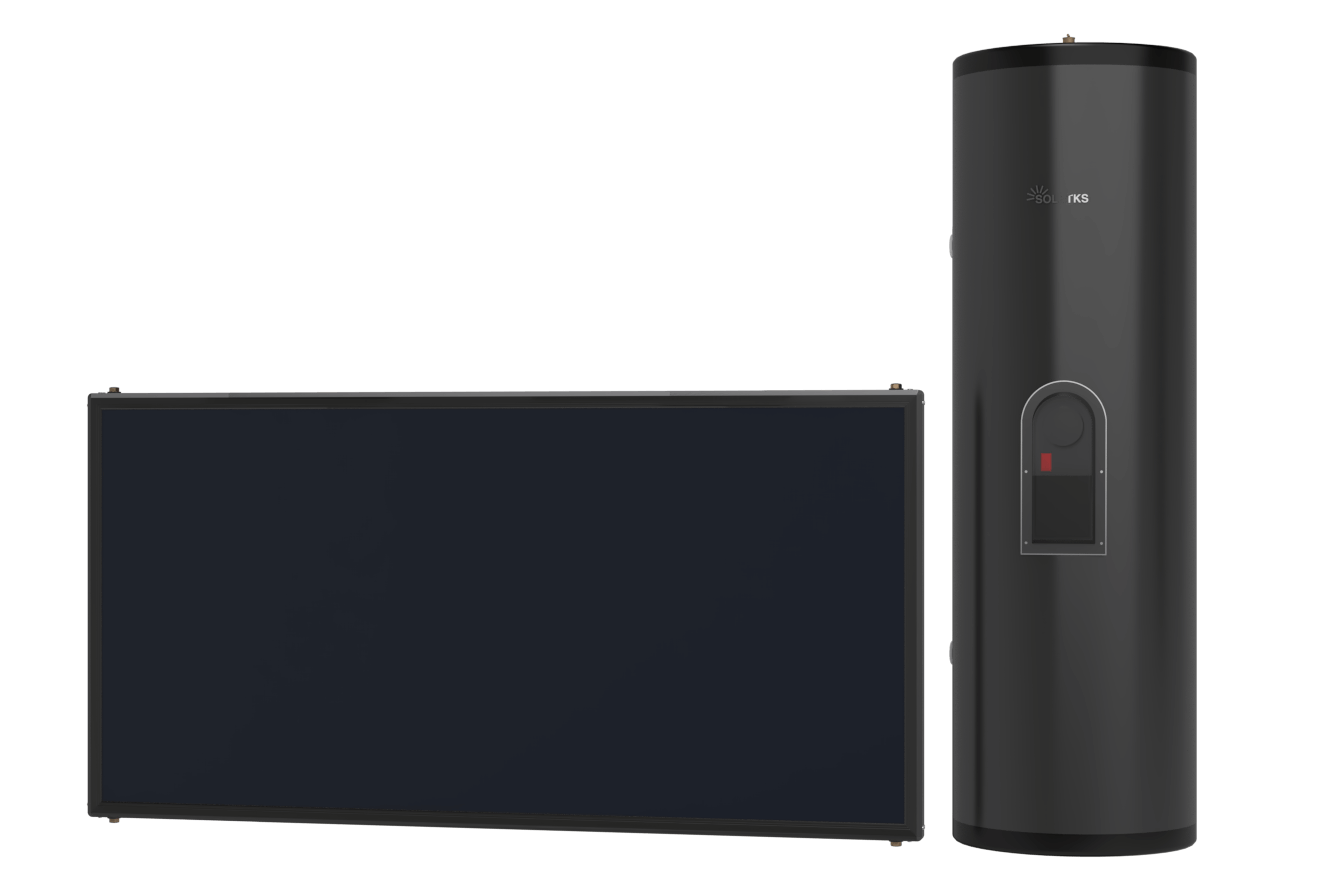
Architecture 2
Split pressurized systems move the heavy tank indoors and make multi-floor supply easier to control.
The added pump, controller and glycol loop are worth it when the site has freeze risk, longer pipe routes, or needs cleaner roof aesthetics.
Soletks Real-Product Comparison
| Specification | ET-300 (compact) | Split 300L (indoor) | Flat-Plate Split 500L |
|---|---|---|---|
| Architecture | Integrated thermosiphon | Indoor tank + glycol loop | Indoor tank + pump station |
| Tank volume | 300 L | 300 L | 500 L |
| Inner material | 2.5 mm enamelled steel | SUS304 / SUS316L | SUS304 / SUS316L |
| Working pressure | 7 bar | 7 bar | 7 bar |
| Internal coil | None (direct) | Optional Cu/SS 12×1.0 mm | Optional dual coil |
| Collector | Twin Soletks2.0-2 | BTE-2.0(3), 3 × 2 m² | BTE-2.0(4), 4 × 2 m² |
| Aperture (total) | ~4 m² | ~5.6 m² | ~7.5 m² |
| Backup heater | 2.0 kW electric | 1.5–3.0 kW | 1.5–3.0 kW |
| Expansion vessel | Compact internal | 12 L | 24 L |
| Pump / controller | None (natural circ.) | Grundfos/Wilo + SR258/FTC-6 | Grundfos/Wilo + controller |
| Typical daily output | 200–300 L @ 50 °C | 250–400 L @ 50–55 °C | 400–600 L @ 50–55 °C |
| Best fit | Villa, 3–4 people, mild | 4–6 people, multi-floor, cold | Guesthouse, 6–10 people |
The tank inner material matters. The compact ET-300's enamelled steel tank with magnesium anode suits direct mains water in hard-water regions. The split-system stainless tanks (SUS304 standard, SUS316L for high-chloride coastal/chlorinated supply) are designed for indoor placement and indirect glycol-loop heating through an internal coil.
200L Sizing Calculation
Heat demand   = volume × ΔT × 0.001163
              = 200 × 40 × 0.001163 = 9.30 kWh/day

Required solar heat = 9.30 × 60% = 5.58 kWh/day

Aperture (winter screen) = 5.58 ÷ 2.5 = 2.23 m²
Aperture (annual screen) = 5.58 ÷ 3.5 = 1.59 m²
| Input | Value |
|---|---|
| Daily hot-water volume | 200 L/day |
| Cold-water inlet | 15 °C |
| Target temperature | 55 °C |
| Temperature rise (ΔT) | 40 °C |
| Daily heat demand | 9.30 kWh/day |
| Solar contribution target | 60% |
| Aperture (winter screen, 2.5) | 2.23 m² |
| Aperture (annual screen, 3.5) | 1.59 m² |
| Recommended aperture (derated) | 2.5–4.0 m² |
| Equivalent BTE-2.0-2 panels | 1–2 panels |
Field example. A Soletks villa RFQ specified 210 L/day measured use, 3.5 bar static mains, and 5 m² of available roof. The recommendation: a Soletks split 300 L pressurized tank (SUS304, 7 bar) with three BTE-2.0(3) flat-plate panels (5.6 m² aperture), a Grundfos 15-65 pump, an FTC-6 controller, and a 12 L expansion vessel — putting the tank indoors for stable multi-floor pressure with closed-loop freeze protection.
Coil-Tank Design Logic
A coil-tank mains-pressure system uses an internal heat exchanger to physically separate stored heating-loop water from domestic outlet water. It is the right default when (a) the collector loop uses glycol, (b) potable-water regulations require non-mixing, or (c) the local water is hard or aggressive.
| Coil design item | Soletks reference value | Why it matters |
|---|---|---|
| Coil material | Copper / SUS304 / SUS316 | Copper transfers best; SUS316 resists chloride |
| Coil tube size | 12 × 1.0 mm (standard) | Wall thickness drives pressure rating + transfer |
| Coil area | 0.7–1.5 m² per 100 L tank | Sets heat-transfer at peak draw |
| Coil position | None / bottom / upper+bottom dual | Dual coil enables boiler integration |
| Domestic pressure rating | ≥ 6 bar (7 bar standard) | Protects mains outlet side |
| Collector loop fluid | Water or 30–50% PG | Affects freeze protection and life |
| Scale control | Annual inspection; softener if >25 °fH | Protects heat-transfer surface |
A simple coil-sizing rule: plan 1.0 m² of coil per 100 L of tank volume as a starting point, and request the supplier's coil-rating curve (kW transferred at stated tank vs mains ΔT). Coil too small means outlet temperature drops during high flow even when the tank is hot; coil too large adds cost without benefit. Mineral deposits insulate the coil wall over time, so hard-water sites should plan for annual descaling or stainless coils with a softener.
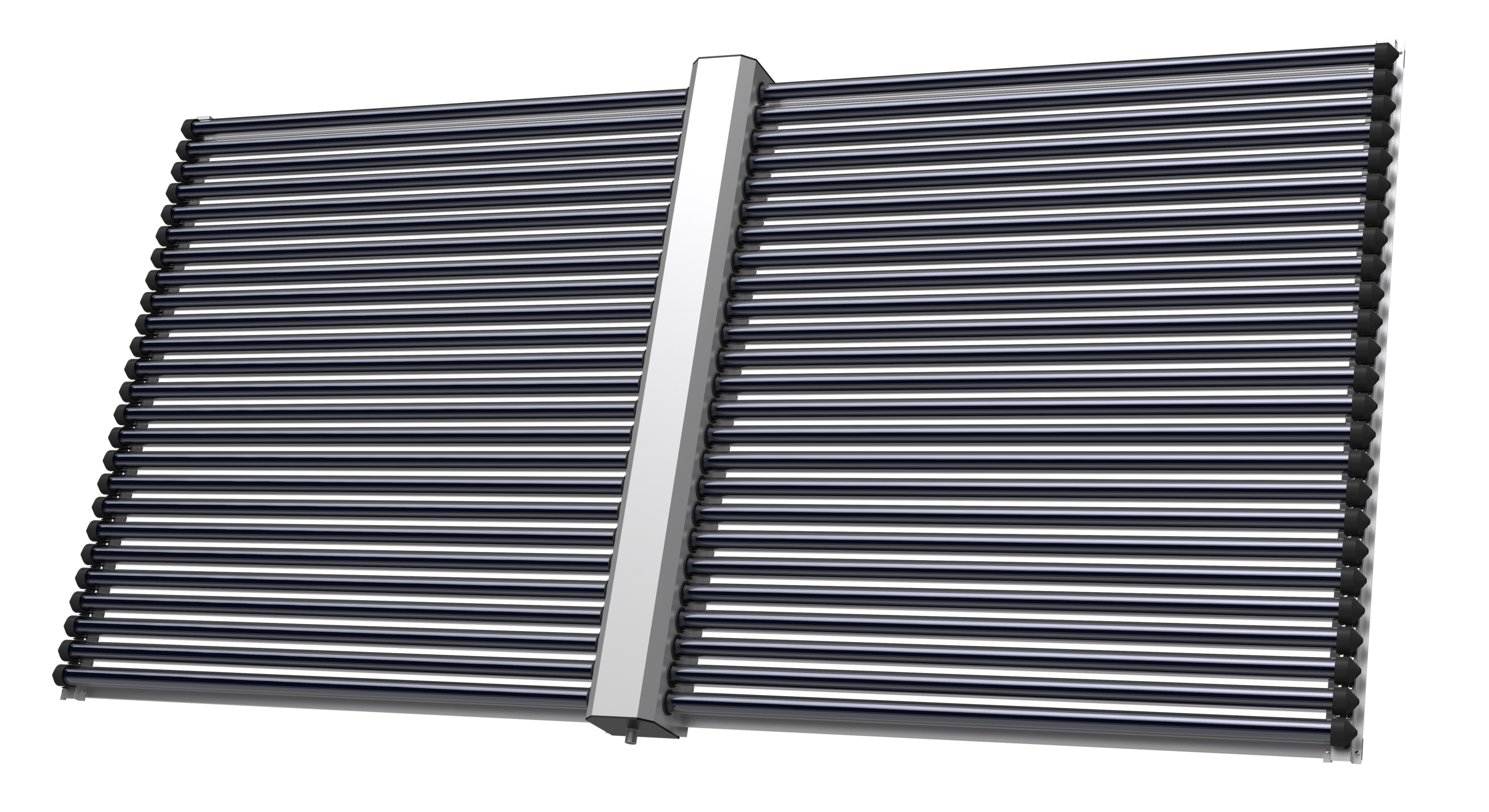
Architecture 3
Coil-tank indirect design protects potable water while still delivering mains-pressure outlet flow.
The internal coil separates the collector loop from domestic water, which is useful for glycol systems, hard-water sites and projects with stricter potable-water rules.
Lifecycle and Maintenance Matrix
| Architecture | Service life | Maintenance focus | Lifecycle risk |
|---|---|---|---|
| Compact pressurized 150–300 L | 10–15 yr | Valves, magnesium anode (yr 3–4), frame | Roof load, weather, anode wear |
| Compact pressurized 500 L | 10–15 yr | Valves, frame, insulation | Heavier roof load |
| Split pressurized 300–500 L | 15–20 yr | Pump, controller, expansion, glycol | More components, glycol every 5–8 yr |
| Coil tank | 15–20 yr | Coil descale, anode, heat-transfer check | Scale buildup if water is hard |
| Flat-plate split 500–1,000 L | 15–25 yr | Glycol, pump, absorber, coil | Design quality & service access |
Exposed rooftop tanks see more UV, thermal cycling and harder access (an anode change at 8 m costs 4× the indoor equivalent). Indoor split tanks add pumps and controllers but live in protected environments. Coil tanks add heat-transfer surfaces that need clean water — annual descaling or a softener is non-negotiable in 25+ °fH water.
Standards and Documents to Request
A mains pressure solar water heater proposal should include collector, pressure, potable-water and installation documentation: ISO 9806 (collector thermal performance), EN 12975 (legacy reference), EN 12976 (factory-made systems), Solar Keymark, NSF/ANSI 61 (drinking-water contact materials — important for tanks and coils), EN 806 (potable-water installations), EN 1717 (backflow protection — directly relevant to coil-tank indirect designs), ASME BPVC Section VIII / PED 2014/68/EU (pressure-vessel rules), and ISO 9001. For coil tanks, ask for the coil's pressure test certificate and rating curve at the project's tank/mains ΔT.
For source documents, use ISO 9806, NSF/ANSI 61 and BSI EN 806.
RFQ Inputs for Soletks
A useful mains-pressure RFQ gives the pressure, load, roof and water-quality data before asking for a model. The difference between compact, split and coil-tank can be 30–50% of project cost.
Include the following in your inquiry
Submit the inquiry through the Soletks inquiry page and request a mains-pressure selection comparison. A useful reply should compare pressure rating, tank location, collector area, roof load, freeze method and service access in one side-by-side table.
Specification Checklist
| Specification item | Value to include |
|---|---|
| Architecture | Compact / split / coil-tank / flat-plate split |
| Tank volume | L |
| Inner material | 2.5 mm enamelled steel or SUS304/SUS316L |
| Working pressure | bar (≥ 6, ideally 7) |
| Safety valve setting | bar (≤ tank rating) |
| Collector type & area | Flat-plate or ET; m² aperture |
| Internal coil (if any) | Material, m² area, position |
| Expansion vessel | L (12/24/50 L by tank size) |
| Pump & controller | Grundfos 15-65 / Wilo ST20-11 + controller |
| Mixing valve | 45–48 °C at fixtures (EN 806) |
| Freeze protection | Method + design minimum temperature |
| Documents | Datasheet, pressure cert, Keymark, manuals, warranty |
Pressure and Water-Quality Decision Notes
The right mains-pressure architecture depends on measured pressure and water chemistry, not on the label "pressurized". Static pressure, dynamic pressure during shower flow, number of floors, and roof load should be collected before the model is chosen. A compact rooftop unit can be correct for a single-storey villa with 3 to 5 bar mains and a strong roof. The same unit can be the wrong choice for a multi-floor apartment, a freezing climate, or a hard-water site where the tank or coil will scale quickly.
| Site condition | Preferred architecture | Reason |
|---|---|---|
| Single-storey villa, mild climate, sound roof | Compact pressurized | Fast installation and lowest component count |
| Multi-storey building or roof-load limit | Split pressurized | Indoor tank lowers roof mass and improves service access |
| Freeze risk or long roof-to-plant run | Split glycol loop | Pump station, controller and protected pipe routing are easier |
| Hard water, aggressive water, or potable isolation rule | Coil-tank indirect | The heat-exchange coil separates loops and simplifies maintenance |
| Existing boiler or heat pump integration | Dual-coil or preheat tank | Solar preheats while backup controls final temperature |
Serviceability should be considered over a 15-year life. Compact systems are simple because the tank and collectors ship as one package, but they place water mass, frame load and service work on the roof. Split systems add pump and controller cost, yet they protect the tank indoors and make anode, coil, valve and sensor service easier. Coil-tank systems add heat-exchanger detail, but they are often the safer long-term choice where water hardness, glycol isolation or backflow rules are serious procurement constraints.
The final quotation should state the safety chain in plain language: tank working pressure, safety-valve setting, expansion vessel volume, non-return valve position, mixing valve outlet temperature and maintenance access. Those details determine whether the system behaves like normal mains plumbing after installation instead of becoming a roof-mounted appliance that only works under ideal pressure and water-quality conditions.
Compact, split or coil-tank — get the right architecture
Send mains pressure, daily volume, floors, roof load and water hardness. Soletks compares all three architectures on the same technical basis and recommends pump, controller and expansion vessel.
FAQ
Q1.What is a mains pressure solar water heater?
Q2.What is the difference between compact, split and coil-tank systems?
Q3.What working pressure should the tank have?
Q4.What is a solar water heater with a copper coil?
Q5.How much collector area does a 200L mains pressure system need?
Q6.Is a compact or split mains-pressure system better?
Q7.When do I need a coil-tank indirect system?
Q8.What should I send for a mains-pressure quotation?
Sources and Disclaimer
Authority references used in this article include ISO 9806 (solar collector thermal performance testing), EN 12975 (legacy collector reference), EN 12976 (factory-made solar thermal systems), Solar Keymark, NSF/ANSI 61 (drinking-water contact materials), EN 806 (potable-water installation), EN 1717 (backflow protection), ASME BPVC Section VIII and PED 2014/68/EU (pressure-vessel rules), and ISO 9001. Product data are from Soletks published specifications: ET-300 integrated (300 L, 7 bar, 2.5 mm enamelled inner, magnesium anode, 2.0 kW electric backup, D-DOS 93% absorption); Split Pressurized System (300–1,000 L tank, SUS304/SUS316L inner, 7 bar, PU 60–100 mm insulation, 12×1.0 mm Cu/SUS304/SUS316 coil options, 12–50 L expansion vessel, Grundfos 15-65 or Wilo ST20-11 pump, SR258 or FTC-6 controller); BTE-2.0-2 flat-plate collector (2 m² gross, 1.87 m² aperture, 6 bar rated, 78% optical efficiency). The screening calculations, regional pressure ranges, coil-sizing rules and lifecycle values are early RFQ planning values; final selection must use measured mains pressure under peak draw, the building's structural records, the manufacturer's datasheet, the local water-utility hardness report and the installer's assessment.