Chinese
 Español
 Francés
 Deutsch
 Русский
 العربية
 Português
 日本語
 한국어
 Italiano

Freeze Protection for Solar Water Heating: Glycol vs Drainback vs Heat Pipe Systems
Freeze Protection for Solar Water Heating: Glycol vs Drainback vs Heat Pipe Systems
A solar water heater that freezes once can split a collector riser, crack a manifold or burst outdoor pipework in a single night. In cold regions, freeze protection is not an accessory. It is a core design decision that affects system layout, efficiency, maintenance and lifetime cost.
Short answer: For sites with regular hard frosts, a closed-loop glycol (indirect) system is the most common and dependable choice. A drainback system is equally effective when the collectors and pipes can be sloped to drain completely, and it also protects against summer overheating. Heat pipe evacuated tubes greatly reduce freeze risk at the tubes, but the manifold and pipework still need protection. Recirculation and electric trace heating are only suitable where frost is rare and mild.

In this guide
Why solar water heaters freeze, even when the air is above 0°C
Water expands by about 9% when it turns to ice. Inside a narrow collector riser or a copper pipe there is nowhere for that expansion to go, so the metal deforms or splits.
Many owners are surprised that freezing can happen on nights when the weather forecast shows +2°C or +3°C. The reason is night-sky radiation: on clear, still nights a collector facing the sky radiates heat to space and can fall several degrees below the surrounding air temperature. The collector and the exposed pipe runs on the roof are therefore the first parts to freeze, long before anything indoors.
The parts most at risk are:
- Absorber risers and headers of flat plate collectors
- The manifold of evacuated tube collectors
- Uninsulated or poorly insulated outdoor pipework and fittings
- Rooftop storage tanks on direct thermosiphon systems
- Valves, sensors and air vents installed outdoors
For a broader view of how solar water heaters perform in the cold months, see our guide Do solar water heaters work in winter?
The 5 main freeze protection methods
1. Closed-loop glycol (indirect) systems
In a closed-loop system, the collector circuit is completely separate from the potable water. A mixture of water and food-grade propylene glycol circulates through the collectors and transfers heat to the storage tank through a coil or an external plate heat exchanger. Because the fluid has a much lower freezing point than water, the collectors can sit full all winter without damage.
Typical freeze protection levels (propylene glycol by volume, approximate):
- 30% → about -13°C
- 40% → about -21°C
- 50% → about -33°C
Choose the mixture from the glycol supplier's chart using the lowest recorded temperature at the site, plus a safety margin. More glycol is not automatically better: higher concentrations are more viscous and transfer heat less well, which increases pump energy and slightly reduces output.
Advantages
- Proven, widely used and suitable for very cold climates
- Works with flat plate, evacuated tube and PVT panels
- No need for special pipe slopes, so it fits most roof layouts
- Pressurised loop gives flexible routing for large commercial arrays
Limitations
- Glycol breaks down over time, especially if the system often stagnates at high temperature in summer. Degraded glycol becomes acidic and can corrode the loop.
- Needs a heat exchanger, expansion vessel, pressure relief valve and fill station, which adds cost.
- Fluid must be tested every year and replaced periodically.

Watch the summer side too. Many glycol problems start in summer, not winter. If a system regularly overheats and stagnates, the fluid ages much faster. Good overheating control protects your antifreeze. Read more in Solar thermal system overheating: causes and solutions.
2. Drainback systems
In a drainback system the collector loop is filled only while the pump is running. When the pump stops, because there is no useful sun, the tank is hot enough, or there is a power cut, gravity drains the fluid out of the collectors and outdoor pipes into a small drainback tank located indoors. With nothing left in the collectors, there is nothing to freeze.
Advantages
- Fail-safe: protection does not depend on electricity or controls working
- Also protects against overheating, because the collectors are empty when the tank is fully charged
- Can use plain water in many climates, or a low glycol mix for extra safety
- Lower long-term fluid maintenance
Limitations
- Every collector and every metre of outdoor pipe must slope continuously back to the drainback tank. A minimum fall of around 2% is commonly specified; follow the collector manufacturer's instructions.
- Collectors must be designed to drain fully. Not every collector or array layout is suitable.
- The pump must be sized to lift fluid to the top of the array at start-up, so pump power is higher.
- The drainback tank must be in a heated space above the frost line.
3. Heat pipe evacuated tube collectors
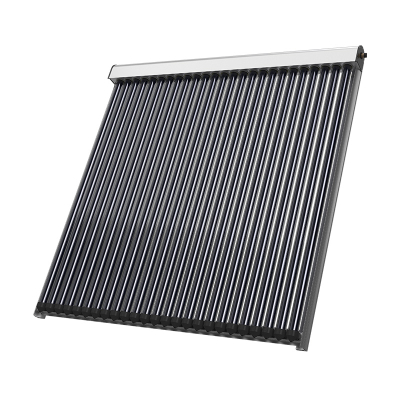
In a heat pipe evacuated tube collector, each glass tube contains a sealed copper heat pipe with a very small amount of working fluid. The heat pipe condenser sits in a dry pocket inside the manifold. The system water or glycol only flows through the manifold header, never through the glass tubes.

Two features make this design strong in cold climates:
- The vacuum between the glass walls almost eliminates heat loss from the absorber, so the collector keeps producing useful heat on cold, clear days.
- The tubes themselves carry no system water, so a frozen night does not crack tubes, and a single tube can be replaced without draining the loop.
Important: heat pipe collectors reduce freeze risk at the tubes, but they do not remove it from the system. The manifold header and the outdoor pipework still contain fluid. In regions with hard frosts, the collector loop should still be a glycol loop or a drainback loop. If you are comparing collector types for a cold site, our article Flat plate vs evacuated tube: which is better? covers the trade-offs in more detail.
4. Recirculation (controller-based) protection
Some direct systems rely on the controller to run the pump when the collector temperature falls close to freezing, pushing warm water from the tank through the collectors.
- Suitable only for climates where frost is rare, light and short
- Uses stored heat and pump energy every frosty night
- Fails if there is a power cut, a pump failure or a faulty sensor, which is often exactly when a cold night arrives
Treat recirculation as a backup layer, not as the primary protection, anywhere frost is a regular event.
5. Freeze valves and electric trace heating
Freeze-protection valves open a small bleed of water when the temperature drops, and self-regulating heat-trace cable can be wrapped around exposed pipes. These are useful as supplementary protection for short exposed pipe runs, valves and fittings. They are not a substitute for a properly designed freeze-protected collector loop, and trace heating adds running cost.
Older draindown systems, which use motorised valves to dump water from an open loop, are rarely recommended today because a single valve failure can cause a freeze-up.
Freeze protection methods compared
| Method | Cold-climate suitability | Works during power cut? | Also protects against overheating? | Installation constraints | Ongoing maintenance |
|---|---|---|---|---|---|
| Closed-loop glycol | Excellent, including severe winters | Yes | No (needs separate overheat control) | Low: flexible pipe routing | Annual fluid test; periodic replacement |
| Drainback | Excellent where layout allows | Yes (drains by gravity) | Yes | High: continuous slope, suitable collectors, indoor drainback tank | Low |
| Heat pipe evacuated tubes | Very good at the tubes; manifold and pipes still need glycol or drainback | Depends on loop design | Partly (some heat pipes have a temperature limit) | Low | Low at collector; loop fluid as per method used |
| Recirculation | Mild, occasional frost only | No | No | Low | Sensor and controller checks |
| Freeze valves / trace heating | Supplementary only | Valves yes, trace heating no | No | Low | Periodic function test |
Which freeze protection method for which climate?
Use the lowest temperature recorded at the site over many years, not the average winter temperature.
Frost-free or very mild frost (rarely below 0°C)
Direct or thermosiphon systems can be acceptable, with good pipe insulation and recirculation or freeze valves as a backup. Typical of coastal tropical and subtropical regions.
Moderate winters (occasionally down to about -10°C)
Choose a closed-loop glycol system or a drainback system. Indirect thermosiphon units with a glycol jacket around the tank are another option for small domestic systems.
Cold winters (regularly -10°C to -25°C)
A pressurised closed-loop glycol system with a suitable concentration is the standard solution. Drainback works well if the building and array layout allow full drainage. Heat pipe evacuated tubes or high-performance flat plate collectors keep output up on cold, sunny days.
Severe winters (below -25°C)
Use a glycol loop with a higher concentration chosen from the supplier's chart, fully insulated and UV-protected outdoor pipework, and a collector type with low heat loss. Check that every component on the loop, including the expansion vessel, valves and sensors, is rated for the expected temperatures.
Extra points for commercial and large-scale projects
Hotels, hospitals, schools, factories and district systems have more collectors, longer pipe runs and higher stakes. A freeze-up can take a whole hot water plant out of service. For these projects:

- Design the collector field as a closed loop with a plate heat exchanger. This separates the glycol circuit from large storage volumes and keeps the glycol volume manageable.
- Balance flow across all rows. Rows with low flow run colder at night and hotter by day, so they are the first to freeze and the first to overheat. Use reverse-return piping or balancing valves.
- Insulate everything outdoors. Use high-temperature, UV-resistant insulation with weatherproof cladding, and pay special attention to valves, sensors and pipe supports.
- Plan for stagnation. A large array left idle on a sunny holiday weekend will stagnate. Use heat dump, night cooling or a correctly sized expansion vessel so the glycol is not damaged.
- Add monitoring. Collector temperature, loop pressure and alarms for low pressure or low temperature let operators act before damage occurs.
Correct sizing matters as much as freeze protection. See how to size a commercial solar hot water system and our commercial solar hot water solutions.
Pre-winter freeze protection checklist
- Test the glycol. Use a refractometer to confirm the freeze point, and check pH. Replace the fluid if protection is too low or the fluid has turned acidic.
- Check loop pressure. Low pressure in a closed loop may indicate a leak or air in the system.
- Inspect pipe insulation. Look for UV damage, gaps at fittings and areas chewed by birds or rodents.
- Test sensors and the controller. A faulty collector sensor can disable both freeze and overheat functions.
- For drainback systems, confirm the collectors drain fully after the pump stops and check that the pipe slope has not changed after any roof work.
- Check the backup heater, because winter solar output will be lower and the backup will work harder.
For a complete service routine, see our solar thermal system maintenance guide.
FAQ
What is the best freeze protection method for a solar water heater?
For climates with regular hard frosts, a closed-loop glycol system is the most widely used and reliable option. Drainback is a strong alternative where the collectors and pipes can be sloped to drain fully. Recirculation and trace heating are only suitable where frost is rare and mild.
What glycol concentration should a solar hot water system use?
Set it by the lowest expected site temperature plus a margin. As a guide, about 40% propylene glycol gives protection to roughly -21°C and about 50% to roughly -33°C. Always follow the glycol supplier's chart and the collector manufacturer's instructions.
Do heat pipe evacuated tube collectors need antifreeze?
The heat pipes are sealed and carry no system water, so the tubes are well protected. The manifold and outdoor pipework still carry fluid, so in hard-freeze climates the loop should still use glycol or be designed as drainback.
How often should solar glycol be checked or replaced?
Test the freeze point and pH at least once a year, ideally before winter. Many installers replace the fluid every 3 to 5 years, or sooner if the system often stagnates or testing shows it has degraded.
Can a solar water heater work in sub-zero temperatures?
Yes. A correctly freeze-protected system continues to collect heat on clear winter days even below 0°C. Output is lower than in summer, so a backup heater is usually included, but the collectors and pipework are protected from damage.
Planning a solar hot water project in a cold climate?
Tell us your location, lowest winter temperature, daily hot water demand and roof space. Our engineers will recommend a suitable collector type, freeze protection method and system layout for your project.
Get a project proposal