Chinese
 Español
 Francés
 Deutsch
 Русский
 العربية
 Português
 日本語
 한국어
 Italiano

Factory Solar Hot Water Systems: Dorm DHW & Process Preheating Guide
Factory Solar Hot Water Systems: How to Evaluate Dorm DHW and Process Preheating
This guide is written for EPC contractors, distributors, project developers, and procurement managers evaluating whether solar thermal belongs in a factory project — and if so, which system path, sizing approach, and integration strategy makes sense. It also explains what project data to prepare before requesting a quotation from a manufacturer.
Solar preheating and partial-load coverage are now standard design strategies in both commercial DHW and industrial process heat (SHIP) applications. The IEA Solar Heating and Cooling Programme and IRENA both position non-concentrating solar collectors as market-ready for industrial heat demands below 150°C, with preheating as the most common entry point.
In This Guide
Where Solar Thermal Fits in Factory Heat Demand
Dormitories, Canteens, and Washrooms — Stable DHW Loads
Factory dormitory hot water is one of the most straightforward applications for solar thermal. The demand pattern is stable and repeating: workers shower in the morning and evening, the canteen needs hot water for food preparation and dishwashing, and washrooms draw throughout the day. Daily volumes are estimable once you know the headcount and per-person usage assumptions (typically 30–60 liters per person per day at delivery temperatures around 45–60°C, depending on regional standards).
Centralized storage is usually essential. A well-sized storage tank absorbs solar gains during peak irradiance hours and releases them during peak draw. This smooths out the mismatch between when the sun delivers heat and when workers need it.
Process Water Preheating — Reducing the Temperature Lift Before Boilers
The second application is less about replacing the existing heat source and more about reducing its fuel input. Many factory processes need hot water or warm make-up water — cleaning circuits, wash lines, dye baths, food processing rinse water, bottling pre-rinse, chemical dilution water, and feed water entering boilers or steam generators.
In most of these cases, solar thermal works best as a preheating layer. Instead of heating cold inlet water (often 10–25°C depending on season and location) all the way to the process target temperature, the solar system raises it partway. The boiler or electric heater handles the remaining lift. This is the operating principle behind most successful SHIP installations globally.
It is worth asking a direct question: does the factory actually need solar to replace the boiler, or does it need solar to make the boiler burn less fuel? In nearly all retrofit scenarios, the answer is the second one.
When Solar Is Usually a Poor Fit as the Primary Heat Source
Solar thermal is not universally applicable. Projects where it tends to struggle as a primary heat source include those requiring very high target temperatures (above 100–120°C with non-concentrating collectors), those with highly intermittent or batch-only demand that does not align with solar availability, factories with very limited usable roof area relative to the heat load, and processes that cannot tolerate variable solar contribution without adding expensive buffering.
None of these disqualify solar entirely. But they do push the design toward a preheating-only role with a smaller solar fraction, or they may indicate that the project economics do not justify the collector investment.
Temperature Check — Is Your Factory a Good Solar Candidate?
Four Inputs That Define Solar Feasibility
Before evaluating collector types or system configurations, establish four numbers:
Cold water inlet temperature — this varies by season and geography, typically from 5°C in northern winters to 25°C in tropical climates. It directly determines how much temperature lift the solar system must provide.
Required outlet or preheat temperature — for dorm DHW, this is usually 45–60°C. For process preheating, it depends entirely on the downstream process requirement. Define whether solar needs to deliver the final temperature or only a partial lift.
Daily volume — liters per day or tons per day, split by application. Dorm DHW is usually estimated per person. Process demand comes from production data, flow metering, or batch records.
Operating schedule — shift patterns, seasonal variation, and weekend/holiday shutdowns all affect how well solar generation matches demand.
Where Non-Concentrating Solar Collectors Perform Best
Non-concentrating solar thermal collectors — both evacuated tube (including heat pipe variants) and flat plate types — are commercially proven for fluid temperatures up to approximately 100–120°C under favorable conditions. For most factory DHW and low-temperature process preheating projects, the target delivery temperature falls comfortably within this range.
The strongest economic case emerges when the solar system is reducing a large temperature lift for the backup heater. Raising inlet water from 15°C to 45°C before it enters a gas boiler is a fundamentally different proposition from trying to maintain a stable 90°C output from solar alone.
Why Preheating Is Often the Safer First Step
For factories evaluating solar for the first time, preheating is typically the lower-risk entry point. Retrofit risk is lower because the solar loop connects upstream of the existing heating system without replacing it. Integration is simpler — the boiler room continues to operate as before, but with warmer incoming water. Operational continuity is maintained because the backup heater always covers any shortfall. And ROI modeling is more realistic because it is based on fuel displacement rather than full system replacement.
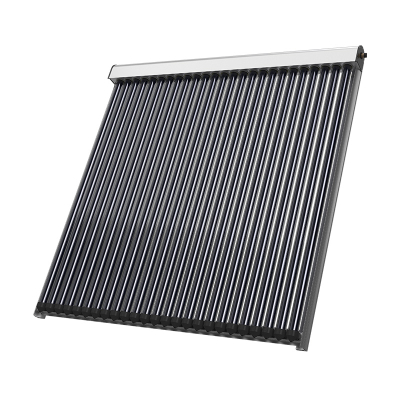
Soletks HPC Heat Pipe Collector
For pressurized systems or higher-temperature process preheating, heat pipe evacuated tube collectors offer a strong technical fit. The Soletks HPC range is designed for pressurized split-system operation, allowing direct integration into pressurized circulation loops without system derating.
View HPC product details →
System Paths for Factory Solar Projects
There is no single correct system architecture for factory solar heat. The right path depends on whether the project is serving DHW, process preheating, or both — and on the temperature, pressure, and integration requirements of the existing plant.
HPC Heat Pipe Collector + Storage + Auxiliary Heater
Best for pressurized centralized systems, projects with higher temperature expectations, and sites that need strong cold-climate and anti-freeze performance. The heat pipe collector operates on indirect heat transfer with a pressurized circulation loop moving heat to storage via a heat exchanger. An auxiliary heater covers periods of insufficient solar gain.
HPC Heat Pipe Collector + Existing Boiler / Steam-Side Preheating
Best for process water preheating in retrofit projects. The solar collector array preheats incoming cold water before it enters the boiler feed system. Hydraulic separation between the solar loop and boiler side is essential. Control logic manages the handoff between solar contribution and boiler output.
FPC Commercial System + Plate Heat Exchanger + Backup
Best for dormitories, washrooms, canteens, and stable factory hot water demand. The Soletks FPC system supports modular collector areas from approximately 10 to 200 m², storage from 500 to 10,000 L, and integrates with electric, heat pump, or gas boiler backup through unified PLC control with remote monitoring.
Solar + Heat Pump Hybrid
Best for sites with stable electricity, high fuel cost environments, and owners targeting stronger annual energy savings. Solar handles the base thermal load during high-irradiance periods while the heat pump covers the gap — delivering a stronger annual solar fraction than solar-only systems.
Design principle: Backup heat and hybrid logic should be treated as standard in factory solar projects, not as optional extras. Commercial guidance and real-world SHIP installations consistently position auxiliary heating as a core system component.
How to Size a Factory Solar Hot Water System
Define the Daily Load
Start with actual demand data, not assumptions. For dorm hot water: headcount, usage per person, draw pattern. For process preheating: metered flow rates, batch volumes, or production-line water consumption records. Separate the two loads if both exist — they will have different profiles, peak windows, and operating hours.
Define the Temperature Lift
Document the cold water inlet temperature range (seasonal low and high) and the required delivery or preheat temperature for each load. Clarify whether the solar system is expected to deliver the final target temperature or only a partial lift. This distinction fundamentally changes the collector area and storage volume.
Estimate the Daily Energy Need
Convert volume and temperature rise into thermal energy demand: energy (kWh) = volume (L) × ΔT (°C) × 4.186 / 3600. State your assumptions clearly — inlet temperature, target temperature, daily volume — so the manufacturer or system designer can verify them.
Estimate Collector Area and Storage Volume
Collector area depends on the local solar resource, collector efficiency at the operating temperature, and the target solar fraction. A solar fraction of 40–70% is typical for well-designed commercial and industrial systems. Storage volume depends on the timing mismatch between solar gain and hot water draw.
Size the Backup for Reliability
The backup heater must be sized to cover the full load independently during cloudy periods, seasonal lows, and maintenance downtime on the solar side. In factory applications, production continuity is non-negotiable. The solar system reduces annual fuel cost; the backup guarantees uninterrupted operation.
Check Roof and Plant Room Constraints
Available roof area, shading, roof orientation and tilt, and structural loading limits all constrain the maximum collector array. Inside the plant, available space for tanks, pumps, heat exchangers, and piping runs determines what configurations are physically feasible.
These six steps produce the project data package that a manufacturer needs to provide a meaningful quotation — not a generic price list, but a system configuration matched to the actual project.
Integration Details That Prevent Operational Problems
Heat Exchanger Selection
Plate heat exchangers are standard in commercial and industrial solar thermal systems for separating the solar collector loop from the potable or process water side. Selection criteria include water quality compatibility, maintenance accessibility for descaling, temperature approach (the difference between hot-side outlet and cold-side outlet), and pressure matching between circuits. In hard-water areas or aggressive-chemistry process loops, indirect circulation through a heat exchanger is not optional — it is the only way to protect the collector array.
Controls and Sensors
A properly instrumented system needs collector loop temperature sensors (outlet and inlet), tank temperature sensors at top and bottom, flow measurement, pump status feedback, auxiliary heater enable/disable logic, and alarm outputs. For factory-scale systems, remote monitoring access is strongly advisable — it allows both the system owner and the service provider to track performance, identify faults early, and verify that solar contribution meets design expectations.
Soletks system note: The Soletks commercial system platform supports PLC-based control and remote monitoring as part of the standard system architecture — a feature particularly valuable for EPC-led factory projects.
Water Quality, Scaling, and Corrosion
Water hardness, chloride content, and pH all affect long-term system reliability. High-hardness water causes scaling inside heat exchangers and tanks, reducing heat transfer over time. Chloride-rich water can accelerate corrosion in copper and steel components. Before specifying a system, obtain a water quality report for the factory's water source. If the water is aggressive, indirect circulation with a closed collector loop and a properly selected heat transfer fluid becomes critical.
Freeze, Overheating, and Safety Protection
Expansion vessels, pressure relief valves, and overheat dump or drain-back logic are non-negotiable in any pressurized solar thermal system. In climates with freezing risk, a glycol-based heat transfer fluid in the collector loop prevents freeze damage. Stagnation management — what happens when the system reaches maximum temperature with no draw — must be addressed in the design, not discovered during commissioning.
Operation and Maintenance — What Buyers Should Clarify Before Purchase
Routine Inspection Scope
Periodic visual checks of collector condition, pipe insulation integrity, leak detection at joints and fittings, and sensor/pump operational status form the baseline maintenance requirement. Establish the inspection frequency and scope before the system is commissioned, not after the first fault.
Spare Parts and Serviceability
Confirm availability of replacement pumps, temperature sensors, controllers, and — for heat pipe collector systems — individual tube replacement procedures. Ask the manufacturer whether tubes can be replaced individually without draining the system. This affects both maintenance cost and downtime.
Monitoring and Alarm Strategy
Remote monitoring access, automated fault alarms, performance trend tracking, and periodic energy reporting should be part of the system specification. Without monitoring, degradation in solar contribution may go unnoticed for months, eroding the expected fuel savings.
Who Will Own O&M
Define the O&M responsibility model before purchase. Options include the EPC contractor under a maintenance contract, a local service partner appointed by the manufacturer, the factory's own maintenance team with training from the supplier, or the distributor's after-sales support structure. The choice affects spare parts logistics, response time, and long-term system performance.
ROI and Payback — How to Model It Without Overpromising
Inputs That Matter Most
The dominant variables in any factory solar thermal ROI model are the fuel being displaced (gas, diesel, electricity, coal, steam), the local energy price, the actual annual heat load, the solar resource at the project location, the available roof area (which caps the solar fraction), the cost of the backup energy source, and O&M assumptions including component replacement over the system lifetime.
Why ROI Should Be Shown as a Range
Avoid single-number payback claims. A credible economic model should present low, medium, and high energy-cost scenarios, use conservative solar fraction assumptions, and include realistic maintenance and component replacement costs. Fuel price volatility alone can shift payback by years. Any supplier who quotes a fixed payback period without confirming the project location, fuel type, and load profile should be questioned.
Why Dorm DHW and Process Preheating Should Be Modeled Separately
Even within the same factory, the two loads have different profiles, different operating hours, different reliability requirements, and different displaced fuel values. Dorm hot water typically displaces electricity or gas for a welfare purpose. Process preheating displaces boiler fuel tied to production output. Combining them into a single ROI figure obscures the actual economics of each investment decision and makes it harder to prioritize if budget is limited.
RFQ Checklist — What to Send for an Accurate Quotation
A generic inquiry produces a generic response. To receive a quotation that reflects real project conditions, provide the following data.
Project Location and Site Conditions
Country and city (determines solar resource, climate zone, and applicable standards). Roof type and usable area. Shading from surrounding structures. Roof orientation and available tilt angles. Structural loading capacity of the roof.
Demand Data
Whether the project serves dorm DHW, process preheating, or both. Daily hot water volume in liters or tons. Peak demand profile by hour, shift, or operating cycle. Operating hours and seasonal variation. Number of occupants for dormitory sizing.
Temperature and Process Data
Cold water temperature range (seasonal low and high). Target delivery or preheat temperature. Whether solar is responsible for final delivery temperature or only partial preheating. Required continuity and control stability for process-side integration.
Existing Utility System
Boiler type (gas, diesel, electric, coal, steam generator). Existing hot water or steam loop configuration. Current fuel type and approximate consumption. Existing storage tank and heat exchanger details. Preferred backup energy source for the solar system.
Water Quality and Installation Constraints
Water hardness and chloride content. Known scaling or corrosion history. Available plant room space for tanks, pumps, and heat exchangers. Pipe routing distance from roof to plant room.
Preparing this data before contacting a supplier moves the conversation from introductory to engineering-level immediately — and produces a quotation that is actually comparable across manufacturers.
Ready to Evaluate Solar for Your Factory?
Send your project data to the Soletks engineering team for a preliminary feasibility review, suggested system path, and quotation-ready configuration outline.
Frequently Asked Questions
Can solar thermal support factory process heating?
Yes, but the fit depends on the temperature range and load profile. Non-concentrating solar collectors are commercially proven for process heat applications below approximately 120–150°C. Most successful factory installations use solar as a preheating layer to reduce boiler fuel consumption rather than as a complete replacement for the existing heat source.
Is solar better for dorm hot water or process preheating?
Neither is categorically better — they are different applications with different load profiles. Dorm hot water is typically easier to design because the demand is more predictable and the temperature target is moderate. Process preheating can deliver larger fuel savings in absolute terms but requires more careful integration engineering. Many factory projects address both loads within the same installation.
What temperature range is usually suitable for solar thermal in factories?
For non-concentrating collectors (flat plate and evacuated tube types), the practical operating range for factory applications is typically up to 80–120°C, depending on the collector type and operating conditions. Heat pipe evacuated tube collectors generally achieve higher operating temperatures than flat plate collectors under comparable conditions.
When should solar be used as preheating only?
When the process target temperature is above what solar can reliably deliver alone, when demand is intermittent or poorly matched to solar availability, when the factory cannot accept variable heat input, or when the project is a retrofit where the existing boiler must remain the primary heat source. Preheating reduces fuel consumption without requiring the solar system to guarantee a fixed output temperature.
Can the system work with an existing boiler or steam system?
Yes. Solar preheating systems are commonly integrated upstream of existing boilers or hot water generators. The solar loop preheats incoming cold water, reducing the temperature lift the boiler must provide. Hydraulic separation and proper control logic between the solar contribution and the boiler are essential for stable operation.
Is a heat pipe collector better than a flat plate collector for factory projects?
It depends on the project requirements. Heat pipe evacuated tube collectors generally offer higher operating temperatures, better performance in cold or low-irradiance conditions, and pressurized loop compatibility. Flat plate commercial systems offer simpler integration, standardized modular scaling, and are often more cost-effective for lower-temperature DHW loads. The right choice depends on temperature target, pressure requirements, climate, and project scale.
How much storage is typically needed?
Storage volume depends on the timing gap between solar gain and hot water draw. Systems with evening-heavy demand (such as dormitories) need storage to hold daytime solar gains. As a rough reference, storage is often sized at 40–80 liters per square meter of collector area for DHW applications, but actual sizing should be based on the specific load profile, peak draw pattern, and solar fraction target.
What data is required before requesting a quotation?
At minimum: project location, application type (DHW, process preheat, or both), daily hot water volume, cold water and target temperatures, available roof area, existing boiler or heating system details, and preferred backup energy source. Providing this data upfront allows the manufacturer to propose a system configuration rather than a generic price list.