Chinese
 Español
 Francés
 Deutsch
 Русский
 العربية
 Português
 日本語
 한국어
 Italiano

Durable Flat Plate Solar Collector Selection Criteria for EPC Contractors
Durable Flat Plate Solar Collector Selection Criteria for EPC Contractors
This article is the EPC-focused durability and lifecycle decision page. For a broader product walkthrough (specifications, market positioning, application scenarios), see our Flat Plate Solar Collector Buyer's Guide 2026. This page concentrates on the technical criteria an EPC contractor or procurement engineer must verify before signing a supply contract: absorber coating, glazing, frame, insulation, pressure rating, ISO 9806 test data, lifecycle heat and warranty terms.
01Short Answer
Quick Verdict
Durable flat plate solar collectors should be selected by absorber coating quality, glazing strength, frame corrosion resistance, insulation stability, pressure rating, ISO 9806 test data, warranty terms and field service access — not by peak efficiency or square-meter price alone. The cheapest collector becomes expensive when glass breaks, gaskets fail, output decays or field service is difficult to organize.
For a commercial project, the working benchmark for a durable European-market collector is approximately: PVD selective coating with absorptance ≥ 95% and emittance ≤ 5% at 80 °C, low-iron tempered glass with transmittance > 91%, PU or mineral-wool insulation rated above stagnation temperature, aluminum frame with corrosion protection, working pressure ≥ 0.6 MPa, ISO 9806:2017 thermal performance test report, and a 10-year written collector warranty with a clear claim route.[1] Soletks high-efficiency flat plate collectors are designed against this benchmark; see the high-efficiency flat plate collector page for product-specific data.
For Soletks product paths, use the flat plate solar collector category, high-efficiency flat plate collector page, large-scale flat plate collector options, the flat plate solar collector buyer's guide, and the Soletks contact page.
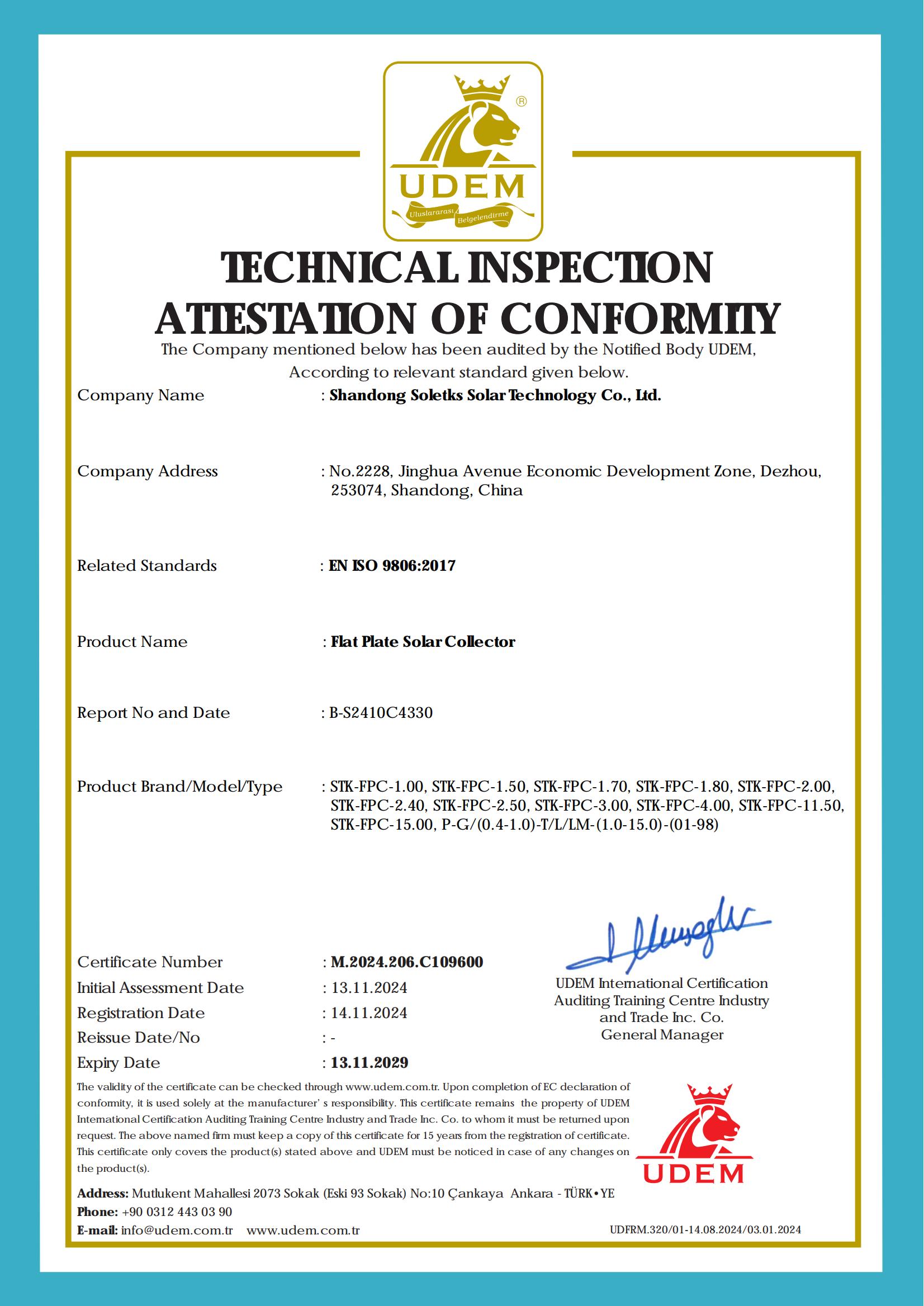 ISO 9806 evidence
Document check
Flat plate collector claims should be tied to a real certificate, not just a product photo.
This technical inspection certificate is useful for the first procurement screen: it confirms the product family, related standard and validity window before the buyer asks for the full ISO 9806 test curve and pressure documentation.
02Key Takeaways
What every EPC procurement file should record
Durability is a system property, not a single material. Absorber + glazing + frame + insulation + hydraulic path all matter.
EPC contractors should buy by lifetime useful kWh, not by price per m². A 25-year collector at moderate yield can deliver ~67% more lifetime heat than a 15-year collector at the same first-year output.
Five must-have datasheet entries: absorptance / emittance, glass transmittance and thickness, working and test pressure, stagnation temperature, ISO 9806 η₀ / a₁ / a₂ coefficients.
ISO 9806:2017 is the current performance standard; EN 12975:2022 now covers collector-field testing rather than individual collector qualification.[2]
Typical flat plate service life: 20–30 years with proper maintenance; NREL evaluation work uses ~25 years as a reference.[3]
Red flag: any proposal without an efficiency curve, pressure rating, stagnation temperature or warranty exclusions list is incomplete and should be returned for clarification.
03What Durability Actually Means
Durability means the collector keeps producing useful heat for the intended service life with acceptable maintenance — not that it looks strong in a brochure. A durable collector survives thermal cycling, rain, wind, hail risk, UV exposure, stagnation temperature, pressure changes, transport vibration and field handling.
Durability has five physical layers, each with its own failure mode:
Because the collector is mounted outdoors for years, small weaknesses compound. A gasket gap lets moisture into the casing; moisture lowers insulation performance; lower insulation raises back loss; higher back loss reduces annual yield and accelerates coating ageing. Durability is therefore an interlocking system, not a feature list.
04Selection Matrix for EPC Contractors
A practical EPC selection matrix scores the collector as a 20–25 year field asset, not only as a lab product.
Source note. Matrix below is a procurement-screening framework. Final selection requires product datasheets, certified test reports, local wind/snow load requirements and installation drawings. Benchmark values in the "Better target" column correspond to current Soletks high-efficiency flat plate collector specifications and equivalent premium European-market products.[1]
| Selection criterion | Minimum commercial expectation | Better target (durable benchmark) | Why it matters |
|---|---|---|---|
| Thermal test data | ISO 9806:2017 test report | Full η₀, a₁, a₂ curve with test conditions stated | Annual yield modeling needs real coefficients |
| Glazing | Tempered solar glass ≥ 3.2 mm | Low-iron tempered glass, transmittance > 91% | Higher transmission and better impact resistance |
| Absorber coating | Selective coating | PVD coating, absorptance ≥ 95%, emittance ≤ 5% @ 80 °C | More heat captured, less re-radiated |
| Peak efficiency η₀ | ≥ 0.70 | ≥ 0.78 | First indicator of optical and thermal quality |
| Working pressure | Stated in MPa | ≥ 0.6 MPa with documented test pressure | Pressurized commercial systems need margin |
| Stagnation temperature | Stated maximum °C | ~190–220 °C, with insulation/seal rated above this | Prevents summer damage when load is low |
| Frame and sealing | Aluminum frame with drainage | Anodized aluminum, anti-rotation threaded connectors, rounded edges | Reduces transport damage and water ingress |
| Insulation | Mineral wool or PU | PU foam with controlled density + heat-resistant edge layer | Reduces back loss under stagnation |
| Warranty | Written term and exclusions | 10-year collector warranty with stated claim route | Converts durability into legal accountability |
| Documentation | Datasheet | Datasheet + test report + drawing + installation manual + O&M manual | Lets EPC review and field engineers reproduce assumptions |
The mechanism is straightforward: absorber quality affects heat gain, insulation affects heat retention, glazing controls optical entry and protects the cavity, and the frame protects all three. A collector with strong lab efficiency but weak seals can lose field output every year because moisture ingress quietly degrades both insulation and coating.
05Lifecycle Heat Calculation
Durability should be converted into lifetime useful heat, not only purchase price. EPC contractors win tenders by quantifying the cost of useful heat over the asset life.
Source note. Worked example below uses screening values for procurement comparison. Replace them with project-specific collector certified yield, local irradiation from NASA POWER or PVGIS, and contract maintenance terms before final tender pricing.[1]
Worked example — 50 m² commercial field
| Input | Value |
|---|---|
| Collector field area | 50 m² |
| Useful annual heat yield | 700 kWh/m²/year |
| First-year useful heat | 35,000 kWh/year |
| Service life scenario A | 15 years |
| Service life scenario B | 25 years |
| Average availability after maintenance | 95% |
Lifetime useful heat = area × annual useful yield × service life × availability

Scenario A (15-year collector):
50 × 700 × 15 × 0.95 = 498,750 kWh

Scenario B (25-year collector):
50 × 700 × 25 × 0.95 = 831,250 kWh

Difference (extra lifetime heat from longer service life):
831,250 − 498,750 = 332,500 kWh   (≈ +66.7%)
Short-life collector
Durable benchmark collector
Recommendation. If two collectors have the same first-year output but credible service lives of 15 and 25 years respectively, the longer-life option delivers about 332,500 kWh more useful heat in this example — roughly 9.5 years of extra equivalent first-year production. The EPC should compare installed cost per lifetime useful kWh, not only cost per square meter. Multiple peer-reviewed evaluations use ~25 years as a representative flat plate collector service life for lifecycle analysis.[3]
This 50 m² scale is intentionally selected to match a mid-size commercial reference (such as a 50-room hotel with 3,000 L/day domestic hot water demand at 60% solar fraction); for the underlying load math, see our solar water heating design calculations article.
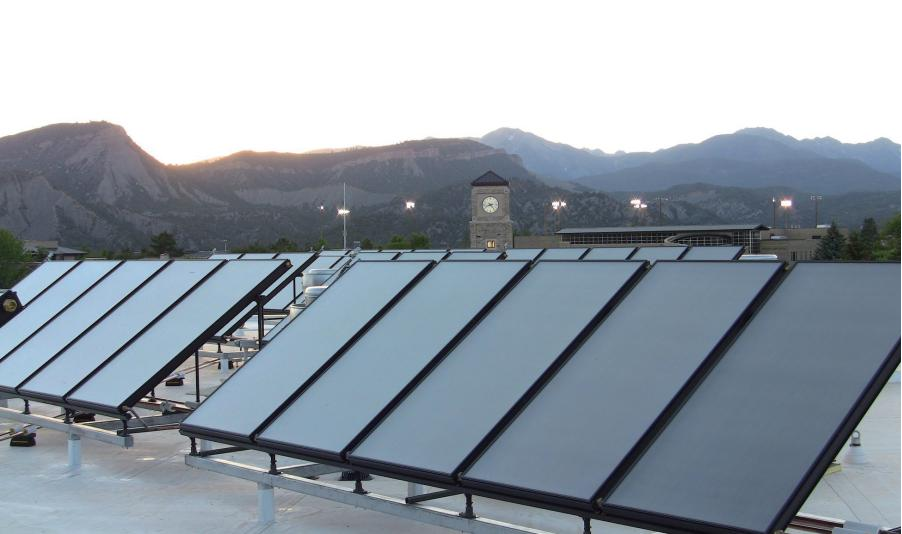
Lifecycle heat reference
Harz Church connects the lifetime-kWh calculation to a real EPC-style installation.
Instead of a full-width project photo, the case now explains why durability, service access and series/parallel layout affect the cost per lifetime useful kWh.
06Durability and Maintenance Matrix
A durable collector reduces unplanned site visits because the vulnerable parts are protected, inspectable and serviceable.
Source note. Intervals below are procurement-comparison guidance. Actual intervals depend on local climate, water quality, glycol condition, dust, wind exposure and the maintenance contract.[1]
| Component | Typical risk | Practical inspection interval | Selection rule |
|---|---|---|---|
| Glazing and gasket | Cracks, seal movement, transmittance loss | 1–2 times/year | Low-iron tempered glass ≥ 3.2 mm + replaceable EPDM gasket |
| Frame and mounting | Corrosion, loose fasteners | 1–2 times/year | Frame and mounting matched to local wind/snow load |
| Absorber and manifold | Internal corrosion, manifold leak | Annual system inspection | Request documented pressure test result |
| Insulation | Moisture ingress, edge shrinkage | Annual visual or thermal check | PU/mineral wool rated above stagnation temperature |
| Heat-transfer fluid (glycol loop) | Glycol ageing, pH drift | Every 1–3 years | ASTM D3306 fluid specification or supplier equivalent |
| Controller and sensors | Sensor drift, pump logic error | Annual commissioning review | Record setpoints, sensor locations and alarm history |
In a project with frequent glass, seal or manifold service, the maintenance cost can erase the savings from a low purchase price. EPC contractors carrying multi-year O&M obligations should price the maintenance scenario, not only the supply scenario.
07Standards and Documents to Request
A durable flat plate collector should come with test data and market documentation that the project reviewer can verify.
Collector performance, durability, reliability and safety testing
Request the full test report with η₀, a₁, a₂ and stagnation temperature.
Solar collector field general requirements and testing
Use when a tender requires collector-field performance verification.
Factory-made solar thermal system testing
Use when a packaged system is quoted.
European solar thermal certification
Required for many EU subsidy and incentive programs.
Drinking-water contact materials
Apply to potable-water contact components in North America.
Glycol heat-transfer fluid specification
Apply to freeze-protected glycol loops.
Pressure vessel design reference
Apply when tanks or heat exchangers fall under pressure-vessel rules.
Industrial control panel reference
Apply when packaged controls require NA electrical review.
Quality management system
Request factory quality documentation when tendered.
For official references, buyers can review ISO 9806 collector testing and ASTM D3306 heat-transfer fluid specification. Standards do not replace project engineering, but they make supplier claims auditable.
Note on EN 12975 wording: many older tenders still name "EN 12975" as if it were the active collector qualification standard. In practice, ISO 9806:2017 now governs the collector itself, and EN 12975:2022 is the re-issued document covering solar collector field general requirements and testing.[2] If a tender mentions "EN 12975", confirm which scope is meant before quoting.
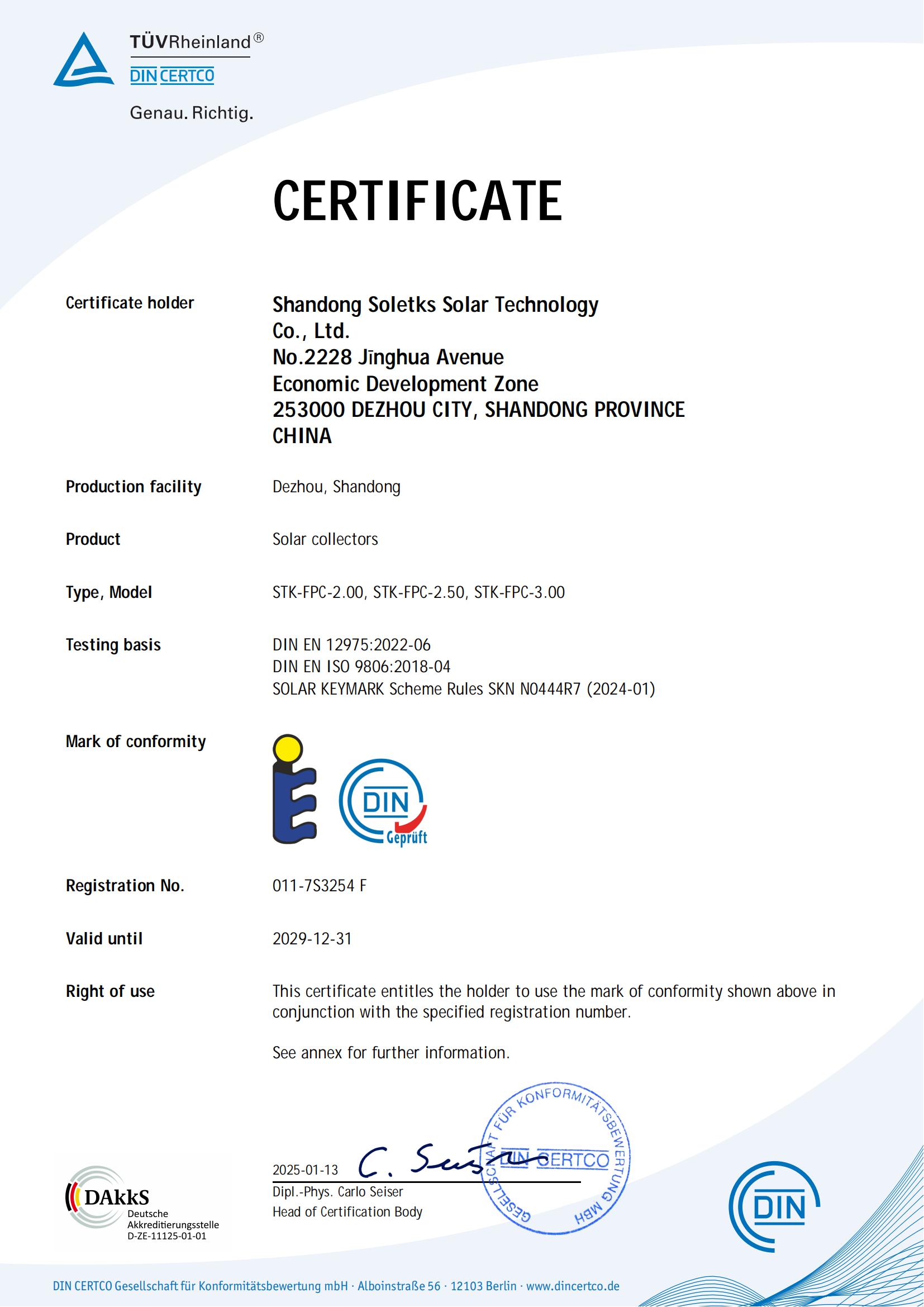 Solar Keymark
Tender document
Solar Keymark is the certificate buyers usually need for EU incentive and public-sector review.
For EPC contractors, this is the document to request early, before contract stage. Match the registration number, model scope and validity date against the collector model quoted in the technical offer.
08Red Flags in a Supplier Proposal
A weak proposal usually hides exactly the durability data that matters in the field. EPC contractors should push back when any of these items are missing:
Proposal red flags
No efficiency curve, only "high efficiency" marketing wording
No absorber coating description (no absorptance / emittance numbers, no PVD or selective designation)
No pressure rating in MPa or bar, and no test pressure value
No stagnation temperature, and no material temperature limit for insulation and seals
No glass type or thickness
No frame material or corrosion-protection method
No warranty document with exclusions and claim route
No installation manual, packing method or spare-part route
No drawing for hydraulic connection and array layout
Each missing item raises EPC risk because the contractor — not the collector supplier — will face the owner during commissioning and the warranty period.
09RFQ Inputs for Soletks
A strong RFQ should tell Soletks the project environment and the tender documents the collector must satisfy.
Send Soletks the following with every RFQ
For engineering support, send the RFQ data through the Soletks contact page and request a flat plate collector durability analysis. A useful answer should compare collector area, expected annual yield, documentation completeness, service interval and long-term project risk — not only a unit price.
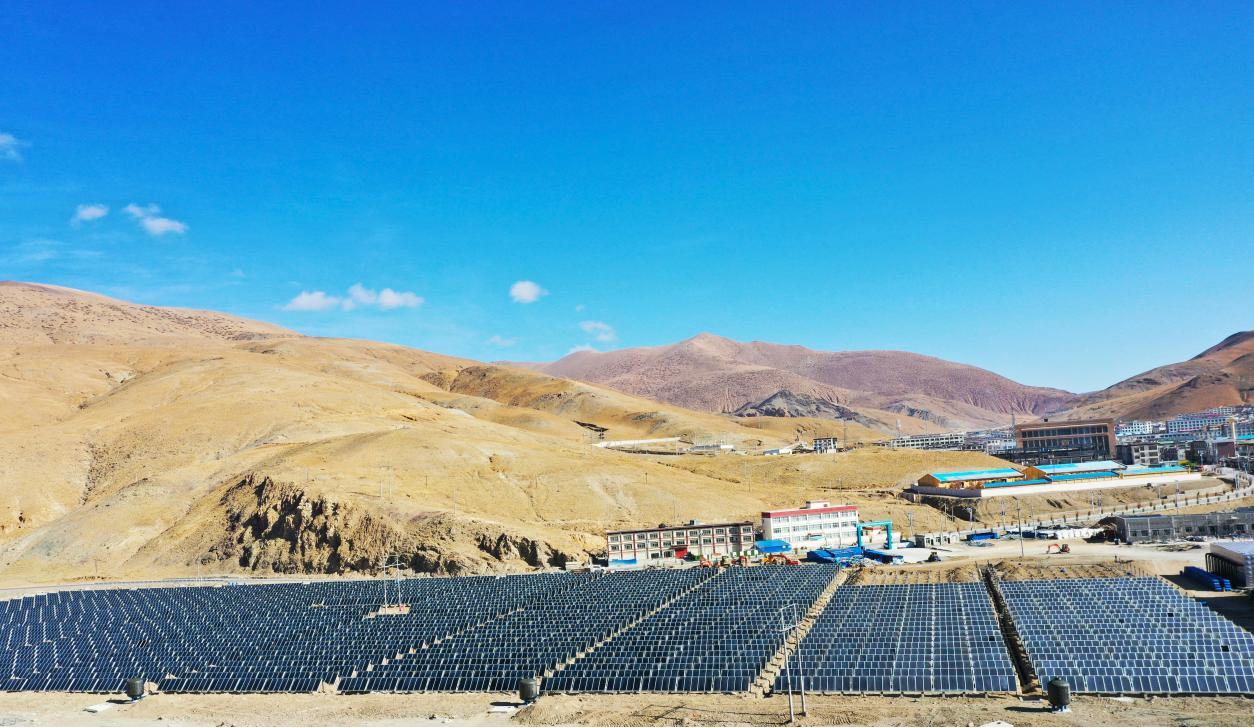
District-heating durability reference
Shigatse shows the operating environment where unit price is the wrong primary metric.
At district-heating scale, durability, lifecycle heat, ISO 9806 reporting and O&M access decide whether the collector field remains valuable after commissioning.
10Specification Checklist
The specification should turn the word "durable" into measurable, contractually enforceable requirements.
| Specification item | Minimum value to include | Why it matters |
|---|---|---|
| Collector area | Gross area and aperture area | Prevents misleading area comparisons |
| Efficiency data | η₀, a₁, a₂ from ISO 9806 test | Supports simulation and yield guarantees |
| Absorber material | Copper or aluminum + construction detail | Controls corrosion and heat-transfer assumptions |
| Coating | Absorptance ≥ 95%, emittance ≤ 5% @ 80 °C, PVD or stated process | Links coating to thermal performance |
| Glazing | Low-iron tempered glass, thickness, transmittance | Affects transmission and breakage risk |
| Frame | Material, corner detail, drainage, anti-rotation connectors | Affects water ingress and transport durability |
| Insulation | Material, thickness, max service temperature | Protects against stagnation damage |
| Working / test pressure | Working pressure (MPa) + tested pressure | Required for pressurized systems |
| Stagnation temperature | °C and material rating | Protects seals and insulation |
| Warranty | Years, exclusions, claim route, regional service | Converts durability into commercial accountability |
| Service access | Spare parts and inspection method | Reduces lifecycle risk |
| Certification | ISO 9806 / Solar Keymark / ISO 9001 as applicable | Supports tender review |
Need a durability-aligned flat plate collector quote?
Send your project country, load profile, area and tender standard. Soletks engineering returns a configuration matched to ISO 9806 data, warranty and lifecycle heat — not just unit price.
11FAQ
Q1. What makes a flat plate solar collector durable?
Q2. How long does a flat plate solar collector last?
Q3. Is a higher-efficiency flat plate collector always more durable?
Q4. What standards should EPC contractors request for flat plate collectors?
Q5. How should I compare two flat plate collector prices?
Q6. What information does Soletks need for a durability review?
Sources
Authority references used in this article include ISO 9806:2017 solar collector testing, EN 12975:2022 solar collector field testing, ASTM D3306 heat-transfer fluid specification, EN 12976 packaged solar thermal system testing, Solar Keymark, NSF/ANSI 61, ASME BPVC Section VIII, UL 508A control-panel references, and NREL flat plate solar thermal collector evaluation reports.
Screening numbers, lifecycle scenarios and service intervals in this article are procurement-comparison values. Benchmark coating, glazing and pressure values reflect current Soletks high-efficiency flat plate collector specifications (PVD coating with absorptance ≥ 95% and emittance ≤ 5% at 80 °C, low-iron tempered glass with transmittance > 92%, PU insulation, aluminum frame, working pressure 0.6 MPa) as published on the Soletks high-efficiency flat plate collector product page. Final project values should come from product datasheets, ISO 9806 test reports, local climate data and contract maintenance requirements.
ISO 9806:2017 — Solar thermal collectors — Test methods governs collector performance, durability, reliability and safety testing. The 2022 re-issue of EN 12975 now covers solar collector field general requirements and testing, complementing rather than replacing ISO 9806 at the individual collector level.
NREL, High Performance Flat Plate Solar Thermal Collector Evaluation (Technical Report NREL/TP-5500-66215), uses approximately 25 years as a reference life expectancy for solar hot water collectors and components. Independent industry reviews report 20–30 year service lives for properly maintained flat plate collectors.