Beijing APEC Summit Leaders Reception Hotel Hot Water Project
50 Tons/Day Solar Hot Water System for a 595-Room 5-Star Hotel at Yanqi Lake, Beijing
The Sunrise Kempinski Hotel Beijing — official reception venue for the 2014 APEC Economic Leaders' Meeting — runs a solar-primary hot water system serving 595 guest rooms and a constant-temperature swimming pool, displacing 60,000 m³ of natural gas and cutting 230 tons of CO₂ per year.
Project Background
The Sunrise Kempinski Hotel sits on the northern shore of Yanqi Lake, a 14 km² ecological zone in Huairou District, Beijing. Designated as the core reception hotel for the 2014 APEC Economic Leaders' Meeting, the property carries a service-quality standard that leaves no room for hot water instability — while operating inside a scenic zone with strict environmental compliance requirements.
During the planning phase, the owner rejected the default option of gas-only or electric-only hot water production. The brief was to build a solar-primary system large enough to carry the full daily load, backed by gas only as an insurance layer against consecutive overcast days. This is a common configuration for large European hotels but was still relatively rare for a diplomatic-grade property in Beijing at the time — see our overview of solar hot water for hotels: design pitfalls, demand profiles, and real-world ROI for how these systems are sized.
Client Challenges
Four operational constraints defined the specification envelope for a hotel of this profile.
Zero Tolerance for DHW Service Failure
595 rooms receiving diplomatic and high-end business guests cannot experience temperature drops or pressure fluctuations during morning and evening peak draw. The hot water system had to hold 45–50°C at every guest tap on demand.
Constant-Temperature Pool Load
The indoor swimming pool must hold 26–28°C continuously and replenish evaporation and turnover losses in real time. This is a 24/7 base load that does not follow the guest-room demand curve.
Beijing Winter + Overcast Risk
Beijing winters bring cold snaps and multi-day overcast stretches. A solar-only system would either be dramatically oversized or expose the hotel to service failure — neither is acceptable at 5-star operating standard.
Ecological Zone Emissions Constraints
Yanqi Lake is a protected scenic and diplomatic zone. Continued reliance on 100% gas combustion carried both regulatory exposure and reputational cost, especially given Beijing's Blue Sky Protection Campaign at the time of commissioning.
Solution Overview
The design pairs a large flat plate solar thermal array as the primary heat source with a gas auxiliary heater as an automatic backup. Solar carries base load; gas fills the delta only when solar plus storage cannot meet setpoint. Two independent hot water loops separate guest-room DHW from pool heating, so a demand spike in one loop never destabilizes the other. Reference product background is available in our solar water heater system hub.
Solar Thermal as Primary Heat Source
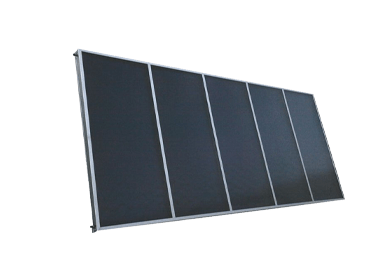
Flat plate collector array sized to deliver 50 tons/day of hot water at design conditions. Base load is carried by solar during any day with reasonable irradiation, which is the majority of the Beijing year.
Gas Auxiliary Module for Continuity
Auto-activated on low irradiation or high demand. Sized to hold setpoint even during multi-day overcast periods. This is the "insurance layer" that lets the hotel commit to solar as primary without service risk.
Two Independent Hot Water Loops
Loop 1: 35 tons/day for guest room DHW at 45–50°C. Loop 2: 15 tons/day for pool make-up water linked to the pool circulation system. Independent controls prevent cross-loop demand collision.
Intelligent Pool Temperature Control
The pool loop is linked to the pool circulation system through a smart temperature controller that replenishes heat losses in real time, maintaining 26–28°C without over-firing gas.
System Configuration
Before vs After Comparison
Benchmarked against a conventional gas-only hot water system serving the same DHW and pool load.
| Metric | Gas-Only Baseline | Solar + Gas Backup | Improvement |
|---|---|---|---|
| Primary Heat Source | Natural gas (100%) | Solar thermal primary, gas insurance | Renewable-first dispatch |
| Annual Gas Consumption | Baseline | Baseline − 60,000 m³ | −60,000 m³/yr |
| Annual Gas Cost | Baseline | Baseline − RMB 200,000 | ~USD 28,000/yr saved |
| Daily Maintenance Cost | Baseline | ~1/3 of baseline | −67% |
| Annual CO₂ Emissions | Baseline | Baseline − 230 tons | −230 t CO₂/yr |
| SO₂ / Particulate Emissions | Baseline | −1.8 t / −0.8 t per year | Direct air-quality gain |
Performance Results
Measured against annual operating data since commissioning.
Client Feedback
"Through the APEC Summit and every international conference since, the hot water system has held setpoint without a service incident — including morning peaks and multi-day overcast weeks. Guests never see the technology. That is exactly the point of specifying it correctly the first time."
Planning DHW and pool heating for a 4–5 star hotel or resort? Get a load-profile-based feasibility outline, or explore our solar thermal distribution partnership if you deliver hospitality EPC projects.
Request a Similar Quote →Key Takeaways for Similar Projects
Four engineering and commercial lessons transfer directly to other high-end hotel and hospitality hot water projects.
Never Cut the Gas Backup on a 5-Star Property
Solar-only sizing is defensible for budget hotels; it is not defensible for a diplomatic-grade property. The gas auxiliary is not a compromise — it is the insurance policy that lets the owner commit to solar as primary. See hotel solar hot water applications for design principles.
Separate DHW and Pool Loops
Guest room DHW is peaky; pool heating is flat 24/7 base load. Combining them on one loop causes cross-demand collision at morning peak. Two independent loops with shared solar generation is the correct architecture.
Size Storage Against Morning Peak, Not Daily Average
Hotel DHW demand peaks between 06:00 and 09:00, before solar comes online. Stratified storage must be sized to carry that peak on stored heat from the previous day — daily-average sizing fails at exactly the wrong hour.
Count Maintenance Savings, Not Just Fuel Savings
At roughly 1/3 the daily maintenance cost of a gas-only system, the solar-plus-gas hybrid delivers ongoing OPEX advantage on top of the fuel savings. Payback models that ignore maintenance underestimate the true return by 15–25%.
Frequently Asked Questions
What is the payback period for a hotel hot water retrofit of this scale?
At RMB 200,000 (~USD 28,000) annual gas savings plus roughly 2/3 lower maintenance cost, most solar-thermal hotel retrofits recover the incremental investment in 5–8 years, with 15–20 years of continued benefit beyond that. Actual payback depends on local gas price, subsidy availability, and property-specific load profile. Our data-driven payback breakdown walks through the calculation methodology.
How is the system sized for a hotel of this size?
Sizing works backward from three inputs: peak-morning DHW draw (not daily average), pool heat-loss rate, and design-day solar irradiation for the site. Our detailed guidance on how to size a commercial solar hot water system for hotels and hospitals covers the full methodology.
How is freeze protection handled through a Beijing winter?
The primary loop uses drain-back or antifreeze protection depending on collector type, combined with insulated piping and continuous circulation control during cold weeks. Freeze protection is a design detail, not an operational one — the guest never sees it. Broader technical background is in our note on freeze protection for solar hot water systems.
Does this design work for boutique hotels below 200 rooms?
Yes. The core architecture — solar primary + gas backup + separated DHW/pool loops + stratified storage — scales cleanly down to 50–200 room properties. Below 50 rooms the payback dynamics change and a simpler pressurized system may be more appropriate.
Does SoletkSolar handle overseas hotel projects?
Yes. The same design logic applies to hotels and resorts across Southeast Asia, the Middle East, the Mediterranean, and Latin America, where irradiation is typically stronger than Beijing and the economics are more favorable. Product specification is adjusted for local water hardness, minimum design temperature, and local code.
Build a Solar Hot Water System for Your Hotel
From feasibility study to commissioning, we deliver solar thermal DHW and pool heating systems engineered around your load profile — not the catalog.